If you have ever glanced at your monthly salary slip and noticed a small deduction labelled LWF and wondered what it means, you are not alone. Thousands of employees across India ask the same question every month: What is LWF in the payslip? The answer, while rooted in labour law, is both simple and important to understand as a working professional.
LWF stands for Labour Welfare Fund, a statutory, state-government-managed, contributory scheme designed to improve the quality of life for workers in India’s organised sector. It is one of several deductions you will find on a salary slip alongside PF, ESI, and Professional Tax. If you need a professional Salary slip generator for your business, you can use our tool.
This comprehensive guide will explain what LWF is in my payslip, what the LWF rate is in my payslip, from a legal perspective, how it is calculated, which states enforce it, and what benefits you are entitled to under the Labour Welfare Fund scheme, all updated to reflect the latest 2025–26 regulatory changes.
What is LWF in Payslip?
LWF’s full form is Labour Welfare Fund. When you see LWF as a deduction line item on your monthly salary slip or payslip, it represents the amount your employer has deducted from your wages as your contribution towards the state-government-managed Labour Welfare Fund.
The Labour Welfare Fund is a statutory contributory fund constituted by individual state governments in India to provide welfare services and socio-economic support to workers in the organised sector. It was conceptually introduced under the broader ambit of the Industrial Disputes Act of 1947, which sought to improve labourers’ working conditions and standards of living. Over subsequent decades, various state legislatures enacted their own dedicated Labour Welfare Fund Acts to operationalise the scheme.
Who is Eligible for LWF?
LWF eligibility applies to employees, including manual, skilled, and unskilled, and contract workers who are earning below a particular wage threshold, which is set by the individual Indian state laws.
Who is Covered Under LWF?
The Labour Welfare Fund applies broadly to employees working in organisations covered under their respective state’s LWF Act. Generally, the fund covers:
- Factory workers and industrial labour in manufacturing establishments
- Employees of commercial establishments and shops covered under the respective Shop and Establishment Act
- Workers employed by transport services, construction companies, plantation estates, and registered societies
- Contract workers and those engaged through principal employers in covered industries
- Both permanent and temporary employees within the wage threshold set by the state
Who is Exempt from LWF?
Certain categories of workers are generally exempt from LWF deductions, though the exact criteria vary by state:
- Employees working in a managerial or supervisory capacity and earning above a specified wage threshold
- Part-time employees (in most states)
- Apprentices and trainees (in most states)
- Employees engaged in establishments below the minimum employee threshold set by the state
Minimum Employee Threshold by State
Establishments are covered under the LWF Act only if they meet a minimum employee count. Key thresholds as of 2026 include:
| Minimum Employee Required | States |
| 1 or more | Madhya Pradesh, Chhattisgarh |
| 5 or more | Delhi, Maharashtra, Tamil Nadu |
| 10 or more | Haryana, West Bengal |
| 20 or more | Andhra Pradesh |
Karnataka’s threshold was reduced from 50 to 10 employees following the Karnataka LWF Amendment Act, 2025, effective January 7, 2026.
How is LWF Calculated in Your Payslip?
Understanding how LWF is calculated helps employees verify whether the deduction appearing on their salary slip is accurate. Unlike PF, LWF contributions are largely flat amounts in most states, making the calculation straightforward.
Step-by-Step Calculation Example
Scenario: An employee working in Pune, Maharashtra, with a monthly gross salary of ₹45,000.
- State applicable: Maharashtra
- Deduction frequency: Half-yearly
- Employee contribution: ₹25 per half-year
- Employer contribution: ₹75 per half-year
- Total combined LWF contribution: ₹100 per half-year
On the employee’s June payslip, the LWF deduction line will show ₹25, a small but legally mandated deduction. The employer will add their ₹75 share separately and remit a total of ₹100 to the Maharashtra Labour Welfare Board by July 15.
Benefits of the Labour Welfare Fund: What Do You Get?
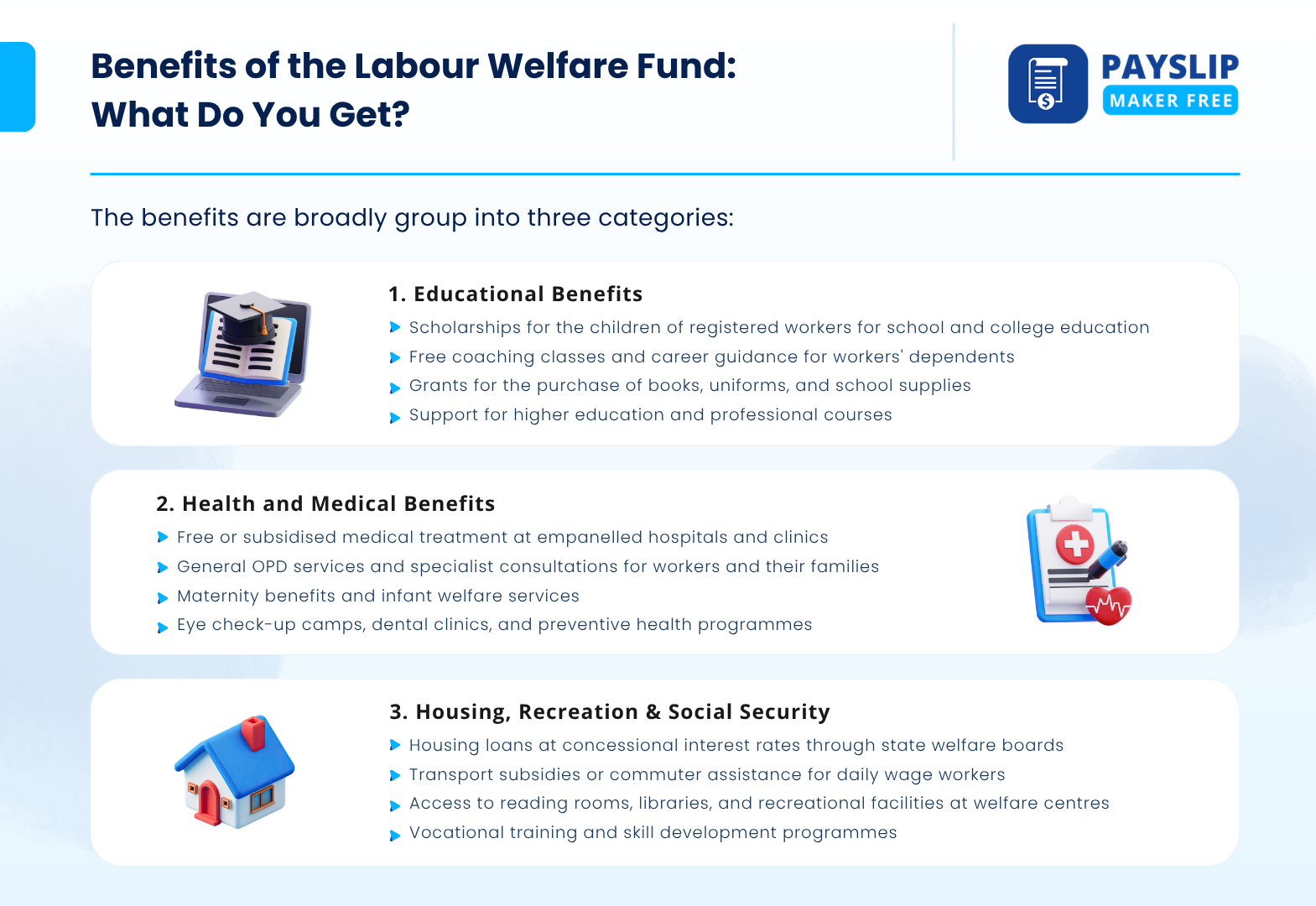
Now that you understand what the labour welfare fund is in my payslip generator from a deduction standpoint, let us focus on what you actually receive in return for your contribution. The Labour Welfare Fund is design to improve the overall quality of life for workers and their dependents through a range of welfare schemes administer by the State Labour Welfare Board.
The benefits are broadly group into three categories:
Category 1: Educational Benefits
- Scholarships for the children of registered workers for school and college education
- Free coaching classes and career guidance for workers’ dependents
- Grants for the purchase of books, uniforms, and school supplies
- Support for higher education and professional courses
Category 2: Health and Medical Benefits
- Free or subsidised medical treatment at empanelled hospitals and clinics
- General OPD services and specialist consultations for workers and their families
- Maternity benefits and infant welfare services
- Eye check-up camps, dental clinics, and preventive health programmes
- Medical assistance for critical illnesses in select states
Category 3: Housing, Recreation & Social Security
- Housing loans at concessional interest rates through state welfare boards
- Transport subsidies or commuter assistance for daily wage workers
- Access to reading rooms, libraries, and recreational facilities at welfare centres
- Vocational training and skill development programmes
- Marriage assistance grants for the daughters of workers (in select states)
- Funeral assistance and death benefits for the family of deceased workers
- Excursions and cultural activities for workers and their families
The exact benefits available to you depend on your state’s Labour Welfare Board and the specific schemes they have launched. Employees can typically access these benefits by registering as a beneficiary with the State Labour Welfare Board and submitting the required documentation.
How to Identify LWF on Your Payslip?
When you receive your monthly salary slip online, the LWF deduction will typically appear under the deductions section. Depending on your employer’s payroll software and formatting, it may be labelle as:
- LWF
- Labour Welfare Fund
- LWF Contribution
- L.W.F. Deduction
As you can see, LWF is typically the smallest deduction on your payslip. However, its presence is legally required, and the employer must remit the combine employee and employer share to the Labour Welfare Board within the stipulate deadline.
Employer Responsibilities Under the LWF Act
Understanding the employer’s obligations under the LWF scheme gives employees a clearer picture of how the entire system works and helps them hold employers accountable.
Under the Labour Welfare Fund Act, employers are legally obligated to:
- Register the establishment with the State Labour Welfare Board within 15 days of commencement
- Deduct the employee’s LWF contribution from their monthly wages in accordance with state-specific rates
- Add the employer’s own contribution
- Remit the combined total to the State Labour Welfare Board before the applicable deadline
- File annual returns and maintain proper LWF records as required by the state government
- Display notices and communicate LWF deduction information to employees
Non-compliance with LWF obligations can result in penalties, fines, and prosecution under the respective state’s Labour Welfare Fund Act. The penalties vary by state but can significantly exceed the original contribution amounts, making timely compliance a critical priority for employers.
Is LWF Deduction Tax-Deductible?
This is another commonly ask question. LWF contributions made by employees are not explicitly list under Section 80C of the Income Tax Act as deductible investments. However, they form part of your overall cost-to-company structure and reduce your taxable take-home income marginally, since they reduce your gross pay.
Employer contributions to the Labour Welfare Fund are treat as a business expense and are generally deductible for the employer under the Income Tax Act. From the employee’s perspective, the LWF contribution is a statutory deduction like Professional Tax and is not separately claimable as a deduction while filing your income tax return.
How to Check and Claim LWF Benefits?
Many employees contribute to LWF for years without ever claiming the benefits they are entitle to. Here is how you can access the welfare schemes under the Labour Welfare Fund:
Step 1: Confirm Your State’s LWF Applicability
Verify that your state has an operative LWF Act (refer to the table in Section 2). If you work in a state without LWF legislation, you are not eligible for these benefits.
Step 2: Register with the State Labour Welfare Board
Visit your state’s official Labour Welfare Board website or office. Submit the required documents, typically including your Aadhaar card, employee ID, salary slip showing LWF deduction, employer registration details, and bank account information.
Step 3: Apply for the Relevant Scheme
Once registered as a beneficiary, browse the available welfare schemes on the board’s website or enquire at their office. Submit the relevant application form with supporting documents for the specific benefit, whether it is an education scholarship, medical assistance, or housing loan.
Step 4: Follow Up and Track Status
Most state Labour Welfare Boards now offer online portals for benefit tracking. Keep your registration number handy and follow up if you do not receive a response within the stipulated timeframe.
Common Misconceptions About LWF
LWF is deducted every month from everyone’s salary: False. In most states, LWF is deducted half-yearly or annually. Monthly deductions apply only in states like Haryana, Punjab, and Delhi.
WF and ESI are the same thing: False. ESI is a central government scheme providing medical insurance to employees earning up to ₹21,000 per month. This is a separate, state-government-managed scheme with different benefits, rates, and applicability.
LWF is a huge deduction that significantly reduces take-home pay: False. This contributions are among the smallest statutory deductions. For example, in Gujarat, the annual employee contribution is just ₹12. Even in states with higher contributions like Maharashtra, the impact on take-home pay is minimal.
If I change jobs, I lose my LWF contributions: Partially true. Unlike PF, there is no universal LWF account portability. However, the benefits funded by LWF are accessible to any eligible employee registered with the State Labour Welfare Board, not tied to a specific employer.
All employees in India are subject to LWF: False. Only employees working in establishments in states with operative LWF legislation, and meeting the applicable employee count and wage thresholds, are subject to LWF deductions.
FAQs
1) What is the LWF in the salary slip?
LWF in the salary slip stands for Labour Welfare Fund, a compulsory deduction from an employee’s salary in India.
2) What is the labour welfare fund in my payslip?
The Labour Welfare Fund in my payslip stands for a mandatory deduction from employee salaries in various states to fund Social Security, Medicare, and housing for workers.
3) Why is LWF deducted from my salary?
LWF is deducte from my salary because it is use to fund social security and raise living standards for employees.
4) What are the benefits of using LWF?
LWF promises services which range from scholarships for workers’ children to healthcare subsidies and recreational facilities.
5) How many times is LWF deducted?
LWF is deducte annually, half-yearly, or monthly.
Key Takeaways
Knowing what LWF in payslip is is not just about satisfying curiosity over a small deduction line, it is about understanding your rights and entitlements as a working professional in India. The Labour Welfare Fund, though modest in its contribution amounts, is part of a broader statutory framework design to provide meaningful social security, healthcare, and educational support to the country’s organise workforce.