Minimum Wages in Kerala 2026: Latest Rates & Compliance Guide

Minimum wages are one of the most important aspects of salary structure in India. If you are an employer, HR professional, or employee in Kerala, understanding the latest minimum wage rules is essential for compliance and fair compensation.

In 2026, the Kerala government has updated wage structures based on skill level, industry, and location. These changes directly impact how salaries are calculated—and how payslips should be generated.

In this blog, we’ll break down everything you need to know about Kerala minimum wages in 2026, along with how you can create accurate salary slips using a payslip maker free tool.

What Are Minimum Wages?

Minimum wages refer to the lowest amount an employer must legally pay employees for their work. These wages are set under the Minimum Wages Act, 1948, and revised periodically by state governments.

In Kerala, minimum wages depend on:

  • Skill level (unskilled, semi-skilled, skilled)
  • Industry (IT, plantation, retail, etc.)
  • Location (district-wise variations)
  • Cost of living (via DA – Dearness Allowance)

What is the Minimum Wage in Kerala in 2026?

The minimum wage in Kerala in 2026 ranges from ₹13,000 to ₹25,000 per month, depending on skill level, industry, and location. Daily wages range between ₹500 and ₹750.

Kerala Minimum Wages 2026 (Latest Update)

As per the latest 2026 updates, Kerala has revised wages for multiple sectors, especially shops & establishments and IT sector employees.

Category Skill Level Monthly Wage (₹) Daily Wage (₹) Notes
Shops & Establishments Unskilled 13,000 – 15,000 500 – 550 Entry-level roles
Shops & Establishments Semi-Skilled 14,000 – 18,000 550 – 650 Requires basic experience
Shops & Establishments Skilled 16,000 – 22,000 650 – 750 Technical or trained roles
IT Sector Entry-Level 15,000 – 18,000 Junior employees
IT Sector Experienced 20,000+ Skilled professionals
Plantation Workers Unskilled 550 – 750 Includes estate benefits
Supervisory Roles Skilled/Highly Skilled 18,000 – 25,000+ Managerial positions

Example: Monthly Minimum Wages (2026)

  • Grade A worker (Ernakulam/Kochi)
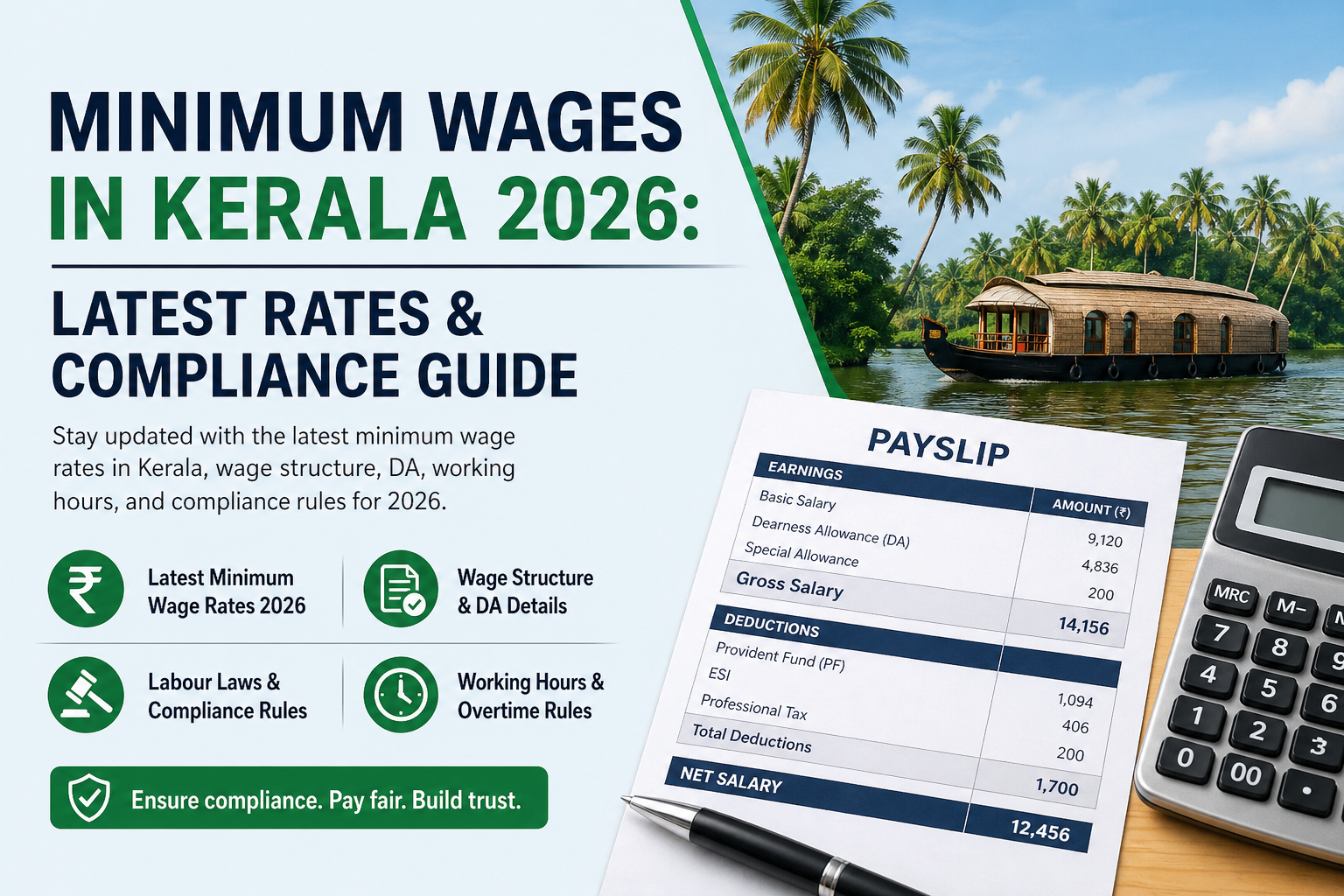
    • Basic: ₹9,120
    • DA: ₹4,836
    • Special Allowance: ₹200
    • Total: ₹14,156/month
  • IT Sector (Entry Level)
    • Approx: ₹15,000 – ₹18,000/month
  • Plantation Workers
    • ₹550 – ₹750 per day

These numbers show how wages vary depending on the job role and industry.

Confused about creating a correct payslip as per Kerala minimum wages?

Use our payslip maker free tool to create a salary pay slip online in seconds.

Generate Your Salary Slip  

District-Wise Wage Variation in Kerala

Unlike some states, Kerala follows a zone-based wage system, meaning salaries differ across districts.

For example:

  • Urban areas like Kochi (Ernakulam) offer higher wages
  • Rural areas may have slightly lower wage slabs
  • Special zones (like Munnar or Idukki) have unique rates

Monthly wages can range from:

  • ₹13,000 to ₹25,000+ depending on grade and sector

This variation ensures wages match the local cost of living.

Skill-Based Wage Categories

Kerala classifies workers into different grades:

1. Unskilled Workers

  • Basic manual work
  • Lowest wage category

2. Semi-Skilled Workers

  • Requires some training or experience

3. Skilled Workers

  • Technical expertise required
  • Higher pay scale

4. Highly Skilled Workers

  • Specialized roles (IT, engineering, etc.)
  • Highest wage category

In some industries, wages for skilled workers can reach:

  • ₹17,940 to ₹21,360 per month or more

Components of Minimum Wage Salary

A proper salary structure in Kerala includes:

1. Basic Pay

Fixed base salary set by the government

2. Dearness Allowance (DA)

  • Adjusted based on inflation (CPI index)
  • Revised periodically

3. Special Allowance

  • Additional fixed amount (varies by sector)

4. Total Gross Salary

Basic + DA + allowances

👉 This is exactly what should appear on a payslip.

Working Hours & Overtime Rules in Kerala

Minimum wage laws also define working conditions:

Rule Details
Daily Working Hours 8 hours
Weekly Limit 48 hours
Overtime Pay 2× regular wage
  • Standard working hours: 8 hours per day
  • Weekly limit: 48 hours
  • Overtime: Paid at double the normal wage

Employers must comply with these rules to avoid penalties.

Why Minimum Wages Matter for Payslips

If you are generating salary slips, minimum wages play a critical role.

For Employers:

  • Ensures legal compliance
  • Avoids penalties and labour disputes
  • Maintains transparency

For Employees:

  • Ensures fair pay
  • Helps in loans, tax filing, and documentation

How to Create a Payslip Based on Kerala Minimum Wages

Using a payslip maker free tool simplifies the process.

Step-by-Step:

  1. Enter employee details
  2. Add basic salary (as per Kerala wage rules)
  3. Include DA and allowances
  4. Add deductions (PF, ESI if applicable)
  5. Generate and download payslip

A good salary pay slip online tool ensures:

  • Accurate calculations
  • Professional format
  • Instant download

Compliance Tips for Businesses in Kerala

To stay compliant in 2026:

✔ Always follow latest wage notifications
✔ Update DA regularly based on CPI
✔ Maintain proper payroll records
✔ Issue monthly payslips to employees
✔ Avoid underpaying below minimum wage

Failure to comply can result in:

  • Legal penalties
  • Fines
  • Business reputation damage

Common Mistakes to Avoid

Many businesses still make errors like:

  • Paying below minimum wage
  • Ignoring DA updates
  • Not issuing payslips
  • Incorrect salary breakup

Using a reliable payslip maker free tool can help eliminate these mistakes.

Future Trends in Minimum Wages (India 2026)

With new labour codes being implemented across India:

  • Wage structures may become more standardized
  • Digital payroll systems will increase
  • Salary transparency will improve

Kerala is already ahead in structured wage systems, making compliance easier for businesses.

Final Thoughts

Kerala minimum wages 2026 are structured to ensure fair pay across industries based on skill level, location, and experience. Employers must follow these wage rules to stay compliant, while employees benefit from transparent salary structures.

Using a payslip maker free tool helps you generate a salary pay slip online that is accurate, professional, and legally compliant.

Frequently Asked Questions

What is the minimum salary in Kerala in 2026?

The minimum salary in Kerala ranges from ₹13,000 to ₹25,000 per month based on job role and skill level.

Is DA included in minimum wages?

Yes, Dearness Allowance (DA) is included and revised regularly based on inflation.

Can employers pay less than minimum wage?

No, paying below minimum wage is illegal and can lead to penalties.

Are minimum wages the same across Kerala?

No, wages vary by district, industry, and skill category.
Paid Time Off (PTO): Meaning, Benefits & How It Works

In today’s fast-paced corporate environment, maintaining a healthy work-life balance is more important than ever. One of the most valuable benefits employees receive is Paid Time Off (PTO). But what exactly does PTO mean? How does it work in corporate settings? And why should both employers and employees understand it clearly?

In this detailed guide, we’ll break down everything you need to know about PTO—its full form, meaning, types, benefits, and how it reflects in payroll systems.

Generate your salary pay slip online to keep track of PTO balances and salary details in one place. Payslip Maker Free helps you manage leave records and create accurate payroll documents instantly.

What is PTO? (PTO Full Form & Meaning)

PTO full form stands for Paid Time Off.

PTO meaning:
Paid Time Off refers to the leave employees can take while still receiving their regular salary. Instead of categorizing leave into separate types (like sick leave or vacation), many companies combine them into a single PTO balance.

Simple Definition:

PTO is paid leave that employees can use for vacation, illness, personal time, or emergencies without losing income.

What is PTO Leave?

PTO leave is the actual time an employee takes off from work using their available PTO balance.

For example:

  • Taking a vacation → PTO leave
  • Staying home due to illness → PTO leave
  • Personal errands → PTO leave

In modern workplaces, PTO gives flexibility and reduces the need for explaining specific reasons.

PTO meaning in Corporate: How It Works

In corporate environments, PTO policies vary by company, but the general structure is similar.

1. Accrual System

Employees earn PTO over time. For example:

  • 1.5 days per month
  • 18 days per year

2. Lump Sum System

Employees receive all PTO days at the beginning of the year.

3. Carry Forward Policy

Some companies allow unused PTO to roll over to the next year, while others follow a “use it or lose it” rule.

4. Approval Process

Employees usually request PTO through HR systems, and managers approve based on workload and availability.

Want to better understand Paid Time Off and manage your payroll easily?

Create accurate salary slips and track PTO in seconds with Payslip Maker Free’s simple online tool.

Generate Your Salary Slip   

PTO Meaning in Office & Workplace Culture

In an office setting, PTO represents more than just leave—it reflects company culture.

A good PTO policy:

  • Encourages work-life balance
  • Reduces burnout
  • Improves employee satisfaction
  • Boosts productivity

Companies that promote PTO usage often see higher employee retention rates.

Types of PTO Leave

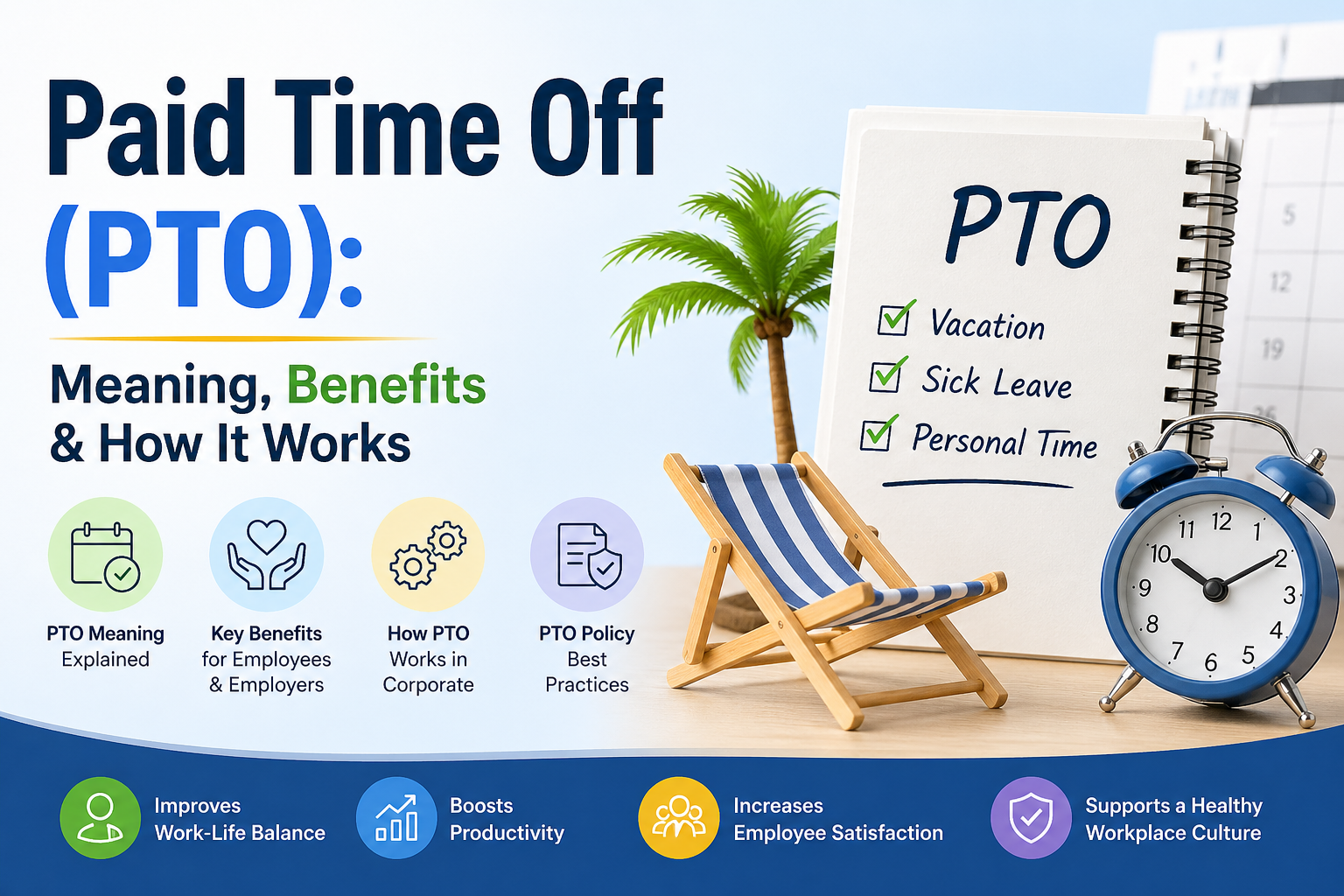
Even though PTO combines multiple leave types, it is commonly used for:

1. Vacation Leave

Time off for travel, relaxation, or personal enjoyment.

2. Sick Leave

Used when employees are unwell or need medical attention.

3. Personal Leave

For personal matters like family events, errands, or emergencies.

4. Mental Health Days

Increasingly common in modern workplaces.

Benefits of PTO for Employees

1. Financial Security

Employees continue receiving salary while on leave.

2. Flexibility

No need to justify the reason for leave in detail.

3. Better Work-Life Balance

Encourages rest and personal time.

4. Reduced Stress & Burnout

Regular breaks improve mental and physical health.

Benefits of PTO for Employers

1. Increased Productivity

Well-rested employees perform better.

2. Improved Retention

Competitive PTO policies attract and retain talent.

3. Simplified Leave Management

One leave category instead of multiple types.

4. Positive Workplace Culture

Builds trust and employee satisfaction.

PTO and Payroll: Why It Matters

PTO is directly linked to payroll calculations. When employees take PTO:

  • Their salary remains unchanged
  • PTO balances are reduced
  • Records must be updated accurately

This is where payroll tools become essential.

How PTO Appears on a Payslip

A payslip typically includes:

  • Total PTO balance
  • PTO used in the current period
  • Remaining PTO days

Accurate tracking ensures transparency between employer and employee.

PTO vs Traditional Leave Systems

Feature PTO System Traditional Leave
Flexibility High Low
Leave Types Combined Separate
Tracking Simple Complex
Employee Freedom More Limited

Common Questions About PTO

What is PTO leave in simple terms?

PTO leave is paid time off from work that employees can use for any personal reason.

What is PTO in corporate?

In corporate settings, PTO is a structured leave policy that combines vacation, sick leave, and personal time.

Is PTO paid?

Yes, employees receive their regular salary while on PTO.

Can PTO be cashed out?

In some companies, unused PTO can be converted into cash, depending on poli

Final Thoughts

Understanding PTO meaning, its structure, and its role in the workplace is essential for both employees and employers. It’s not just a benefit—it’s a crucial part of modern work culture that promotes productivity, well-being, and job satisfaction.

To manage PTO efficiently and ensure accurate payroll records, using a Free Payslip Generator tool is a smart move. It simplifies calculations, improves transparency, and helps businesses stay organized without extra costs.

Also check:

Is There an SSN Number in India? Everything You Need to Know

Form 24Q (Quarterly TDS Return): Meaning & Deadlines 2026

Minimum Wages in Gujarat 2026: Latest Rates & Per Day Salary Guide

What is the Gratuity Form: Everything You Need to Know (2026 Guide)

What is LWD in Job? Everything You Need to Know (2026)

Form 24Q (Quarterly TDS Return): Meaning & Deadlines 2026

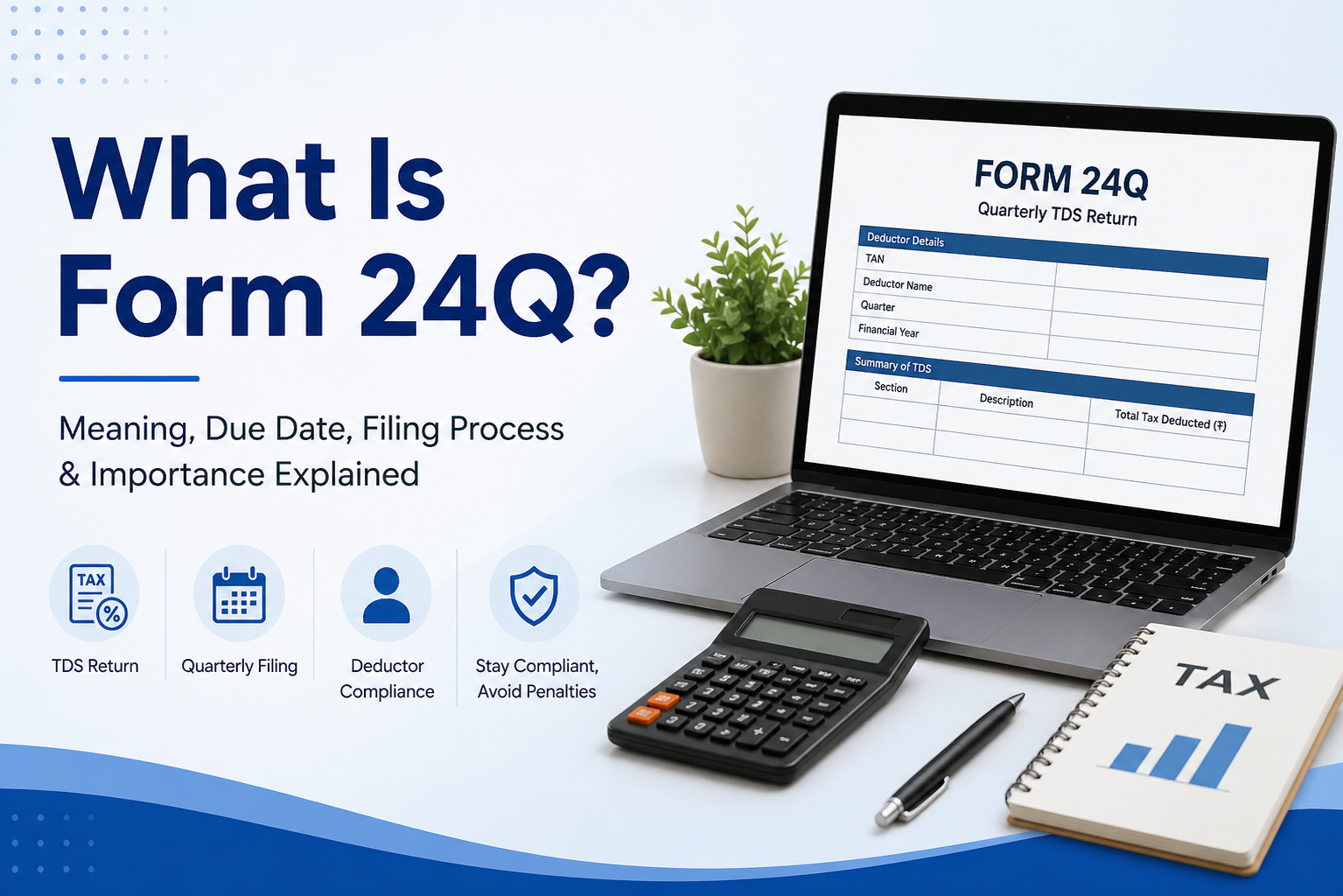
If you’re handling payroll or employee salaries, understanding Form 24Q is essential. It’s one of the most important TDS returns that employers must file every quarter in India.

In this guide, you’ll learn what Form 24Q is, how it works, due dates, and how to file it step-by-step.

Managing salary records becomes easier with an online payslip generator. It helps you create accurate payslips while keeping your TDS and Form 24Q data organized.

What is Form 24Q?

Form 24Q is a quarterly TDS (Tax Deducted at Source) return filed by employers for tax deducted on salary payments under Section 192 of the Income Tax Act.

In simple terms:
Whenever an employer deducts TDS from an employee’s salary, they must report it to the Income Tax Department using Form 24Q.

Form 24Q TDS Return Meaning

The 24Q TDS return is a statement that includes:

  • Employee salary details
  • TDS deducted from salary
  • PAN details of employees
  • Tax paid to the government

It ensures that employees get proper credit for the TDS deducted from their income.

Who Should File Form 24Q?

Any employer who deducts TDS on salary must file Form 24Q, including:

  • Private companies
  • Government departments
  • Startups and SMEs
  • Partnership firms

If you pay salaries and deduct TDS, filing Form 24Q is mandatory.

Form 24Q Due Dates (2026)

Form 24Q must be filed quarterly:

Quarter Period Due Date
Q1 April – June 31 July
Q2 July – September 31 October
Q3 October – December 31 January
Q4 January – March 31 May

Missing deadlines may result in penalties.

TDS quarterly return due dates depend on the filing quarter and must be submitted by employers on time to avoid penalties. For FY 2026, the due dates are 31 July (Q1), 31 October (Q2), 31 January (Q3), and 31 May (Q4). Late filing may result in a penalty of ₹200 per day until the return is filed.

Components of Form 24Q

Form 24Q has two main parts:

1. Annexure I (All Quarters)

Includes:

  • Deductor details
  • Challan details
  • Employee-wise TDS details

2. Annexure II (Only Q4)

Includes:

  • Complete salary breakup
  • Deductions under Chapter VI-A
  • Total taxable income
  • Final tax calculation

How to File Form 24Q Online

Follow these steps:

  1. Prepare TDS return using software or utility
  2. Validate the file using the File Validation Utility (FVU)
  3. Generate the .fvu file
  4. Upload it on the income tax e-filing portal or through TIN-NSDL
  5. Submit with DSC (Digital Signature Certificate) if required

Penalty for Late Filing

If you don’t file Form 24Q on time:

  • ₹200 per day under Section 234E
  • Maximum penalty equals total TDS amount
  • Additional penalty under Section 271H (₹10,000 to ₹1,00,000)

Simplify payroll and avoid errors in TDS reporting.

Keep your salary records organized for easy Form 24Q filing.

Generate Your Salary Slip   

Why Form 24Q is Important

  • Ensures compliance with tax laws
  • Helps employees claim TDS credit
  • Avoids penalties and notices
  • Keeps payroll records accurate

Common Mistakes to Avoid

  • Incorrect PAN details
  • Mismatch in TDS amount
  • Late filing
  • Wrong challan details
  • Not filing Annexure II in Q4

Final Thoughts

Form 24Q is a crucial part of payroll compliance in India. Whether you run a small business or a large company, timely and accurate filing of this TDS return ensures smooth tax reporting and avoids penalties.

If managing payroll feels complicated, using a simple payslip or payroll tool can make tracking salaries and TDS much easier.

NOTE: Managing salary records becomes easier with a free payslip generator, helping you keep accurate data ready for Form 24Q filing and TDS reporting.

FAQs

1) What is Form 24Q used for?

It is used to report TDS deducted on employee salaries.

2) Is Form 24Q mandatory?

Yes, for all employers deducting TDS on salary.

3) What happens if Form 24Q is not filed?

You may face penalties, interest, and notices from the tax department.

4) Can Form 24Q be revised?

Yes, you can file a revised return to correct errors.

5) What is Form 24Q?

Form 24Q is a quarterly TDS return filed by employers to report tax deducted from employee salaries under Section 192 of the Income Tax Act. It includes details like salary paid, TDS deducted, and employee PAN information, ensuring proper tax credit is recorded.

7) What happens if you don’t file Form 24Q?

If Form 24Q is not filed on time, a penalty of ₹200 per day may be charged under Section 234E until the return is filed. Additional penalties ranging from ₹10,000 to ₹1,00,000 may also apply, along with possible notices from the Income Tax Department.

What is Form 16?- A Complete Guide

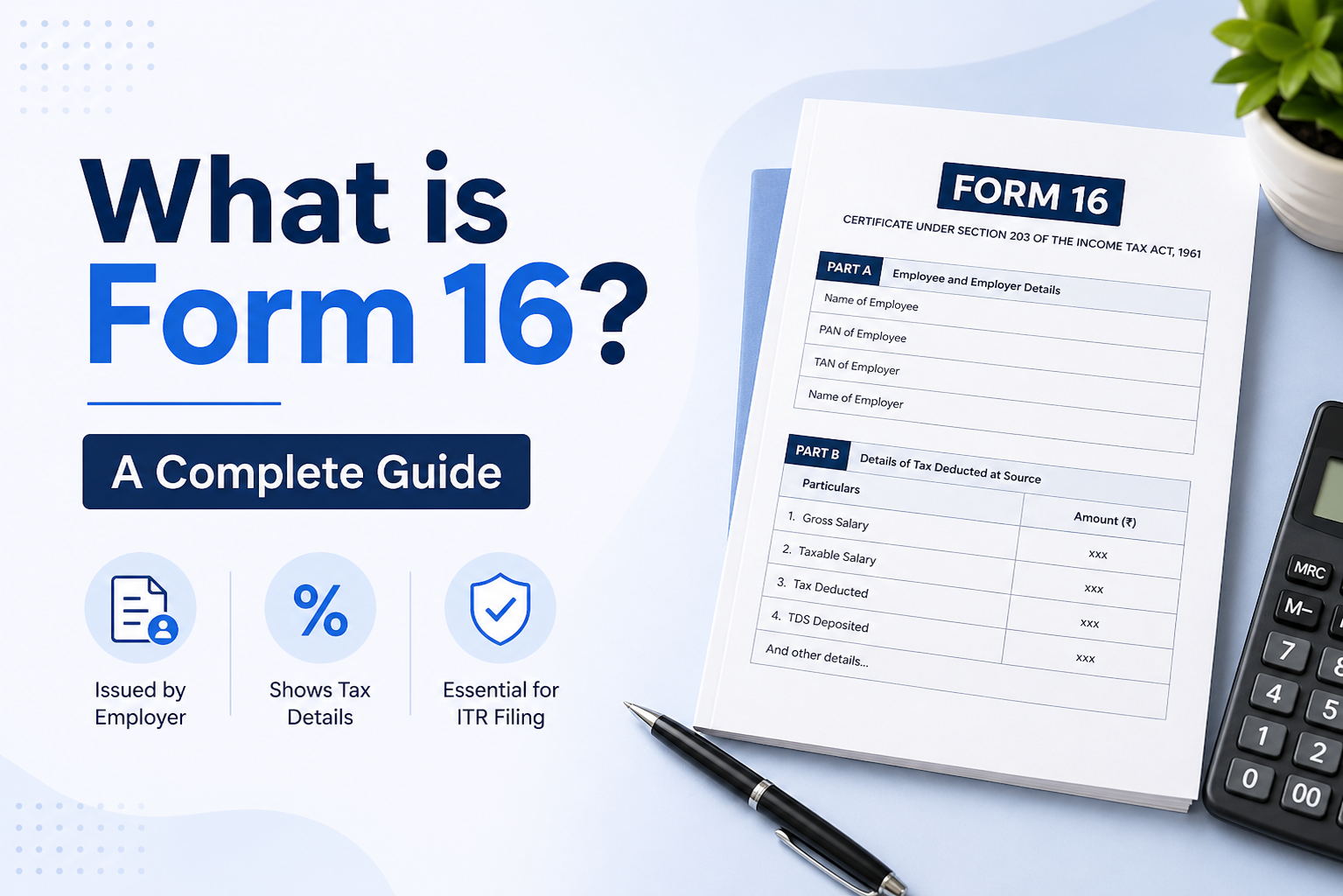
Form 16 is an income tax document issued by an employer that shows your total salary, tax deducted at source (TDS), and the tax deposited with the government.

Form 16 is an important document for salaried employees in India. It is issued by employers and shows your salary, TDS deducted, and tax deposited with the government. Understanding Form 16 meaning and how to download Form 16 is essential for filing your income tax return correctly.

Are you still waiting for your payslip to prove your income? With a pay slip generator, you can create accurate, professional payslips in minutes anytime you need them.

What is Form 16?

Form 16 is a TDS certificate issued by an employer under Section 203 of the Income Tax Act, 1961. It shows your total salary, tax deductions, and the amount of tax deposited with the government.

Why is Form 16 important?

Form 16 is important for each salaried employee in India. Below are some of the reasons behind its significance:

  • Form 16 helps in filing income tax returns, as it contains complete details of your total income, deductions, and tax paid. It also makes it easier to download Form 16 for salaried employees and use it during ITR filing.
  • It works as proof that your employer deducted the tax from your salary.
  • Form no 16 is helpful in loan applications. Many banks ask for it to check your financial stability in the past.
  • It provides you with a clear idea of how much tax you have paid and how your salary is formatted.

Components of Form 16

Below are the components of Form 16:

Part-A:

  • Name and address of the employer and employees
  • TAN of the employer
  • PAN of the employer and employee
  • Quarterly breakdown of the amount of TDS deducted against salary
  • The date on which the monthly TDS is deducted and is deposited with the government

Part-B:

  • Gross salary
  • Exempt allowances under Section 10
  • Income other than salary that is declared for TDS deduction purposes
  • Deductions under Chapter VI-A
  • Total taxable income offered for TDS deduction
  • Estimated tax liability 
  • Relief under Section 89

Form 16 Format (PDF Structure Explained) 

The following is the Form 16 format:

  • Issued as a PDF document
  • Structured in a tabular format
  • Includes calculations, structure, and calculation tables
  • Digitally signed

How to Download Form 16 from TRACES? (Step-by-Step Guide) 

  • In order to download the Form 16 from the Traces portal, employers must log in using their PAN and password. 
  • Navigate to the download tab and select Form 16.
  • Choose Form 16 type and select the financial year.
  • Verify PAN.
  • Insert the TDS receipt number and select the date.
  • Add the total tax deducted.
  • Click on the submit button to download the form.

Income Tax Form 16: Who gets it?

Tax Form 16 is only issued to salaried employees whose employer deducts the TDS on their income under the Income Act 1961. Below is who gets it:

  • Salaried employees working in a company.
  • Employees whose income is taxable and TDS has been deducted by the employer.
  • Employees who have provided PAN details to their employer.

Looking for easy income proof?

If you need quick income proof, you can also create a payslip online using a payslip generator.

Generate Your Salary Slip  

How to get Form 16 Online?

Below is how you can get Form 16 online:

1- From Your Employer

  • Form 16 is issued by your employer
  • Log in to your company’s employee portal
  • Go to tax documents 
  • Download it in PDF format

2- Through Traces Portal

  • Only employers can generate it from the Traces portal
  • You can ask your employer to re-download if needed

3- From Tax Filing Platforms

  • If you use a platform like Clear Tax
  • Your Form 16 is available there if previously updated.

Who receives Form 16?

Below are the following entities that receive Form 16:

  • Salaried employees
  • Employees with TDS deducted on salary
  • People working in a private job

Difference Between Form 16 & Form 16A

Factors Form 16 Form 16 A
Who issues it? Employer Financial Institutions
Frequency Issued annually Issued quarterly
Purpose Evidence that tax is deducted at source from the employee’s income and deposited with the government Issued when TDS is deducted on non-salary income (e.g., interest, commission, rent)
Threshold limit When income exceeds the basic exemption limit When income has crossed the threshold limit for TDS under the respective section
Rates Slab rates Rates as specified under respective sections

Points to remember while checking Form 16

Below are the points to remember while checking Form 16:

  • Once you receive Form 16, you should carefully verify all the details.
  • Make sure to confirm the information mentioned in Form 16, for example, details of the amount of earnings, TDS deductions, and so on.
  • If any information is mentioned incorrectly, the same should be rectified by immediately going to the HR/payroll/finance department of the organization.
  • The corporation could then rectify its relinquishment by filing an amended TDS to again credit the TDS amount against the appropriate PAN. Once the revised TDS return is processed, the corporation will hand the updated Form 16 to its employee.

Key Takeaways

In conclusion, Form 16 is an essential document for every salaried employee, as it serves as a complete summary of your income and the tax deducted by your employer during the financial year. Understanding what Form 16 means helps you file your income tax return accurately, avoid errors, and stay compliant with tax regulations. From verifying your salary details to claiming deductions, this document plays a crucial role in your financial planning.

Also check:

Is There an SSN Number in India? Everything You Need to Know

Form 24Q (Quarterly TDS Return): Meaning & Deadlines 2026

Minimum Wages in Gujarat 2026: Latest Rates & Per Day Salary Guide

What is the Gratuity Form: Everything You Need to Know (2026 Guide)

What is LWD in Job? Everything You Need to Know (2026)

FAQs

1- What does Form 16 means?

Form 16 is an annual TDS certificate issued by employers in India under Section 203 of the Income Tax Act.

2- How to download Form 16?

You cannot directly download Form 16 from a government portal. It is issued by your employer. You can get it by logging into your company’s payroll portal or requesting it from your HR department. Some employers also email Form 16 to employees.

3- How to download Form 16 from Traces?

To download Form 16 from TRACES, employers must log in to the TRACES portal using their User ID, TAN, and password. Navigate to the Downloads tab, select Form 16, choose the relevant financial year, and submit the request. After validation, download the file from Requested Downloads.

4- How to get Form 16 online?

You can access Form 16 online primarily through the TRACES portal, your company’s HR portal/e mail, or the Income Tax Department’s e-summing portal.

5- How to get Form 16?

Form 16 is a TDS certificate issued by employers, which is usually provided by email or through the HR portal in mid-June.

6- What is Form 16 Format?

Form 16 is a TDS certificate issued by employers in India, divided into Part A (Summary of tax deduction/deposit) and Part B (Statement of income and deductions payable). It is important to file Income Tax Return Forms (ITR). The format contains organization/worker PAN/TAN, TDS duty information, and a breakdown of overall earnings.

7- Is Form 16 the same as salary slip?

No. Form 16 is a compulsory file required to be issued under the Income Tax Act. This includes your taxable earnings, TDS deductions, and other information from a profit tax perspective.

8- How do I download my Form 16?

Form 16 is a TDS certificate issued by employers, which is not downloaded directly by employees from the income tax portal. You can get it by requesting it from your enterprise’s HR/Finance branch or logging into the TRACES portal (if registered) to download from the Downloads tab when they generate it.

9- What is Form 16 for PAN Card?

Form 16 is an annual TDS certificate issued by employers, detailing salary paid and tax deduction (TDS) based entirely on your Permanent Account Number (PAN). The Income Tax Return (ITR) is mandatory to file and serves as evidence of significant income, which is normally issued by June 15 for the previous 12 months.

10- Can we check Form 16 online?

Yes, you can check and download your Form 16 online, mostly through the TRACES portal or the Income Tax e-filing portal. Employers generate this document, but employees can access it if the entity has uploaded it, or can confirm the TDS information via Form 26AS/AIS.

11. Can I Download Form 16 PDF Myself?

Employees cannot directly download Form 16 PDF from a government portal. Only employers can generate it through the TRACES portal. However, employees can access and download Form 16 from their company’s HR or payroll portal, or receive it via email from their employer.

12. Form 16 Download PDF – Can You Download It Directly? 

Employees cannot directly download Form 16 PDF from a government portal. It is generated by employers through the TRACES portal and shared via HR portals or email. 

Is There an SSN Number in India? Everything You Need to Know

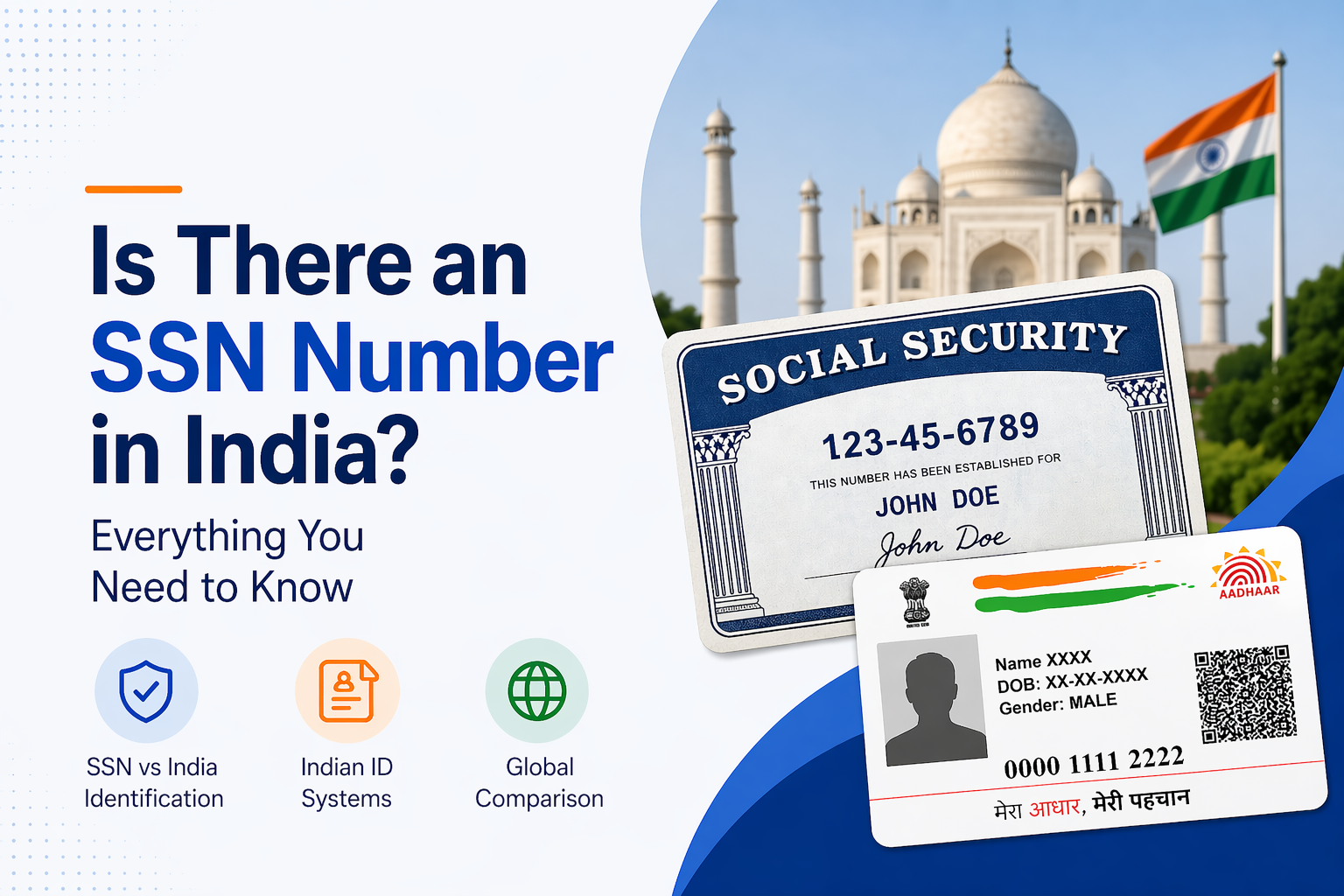
If you have ever filled out an international job form or have applied for a visa, then you might have come across a term known as the “SSN number.” But have you ever wondered: what is ssn number in india? 

India does not have a standard social security number like the U.S. But countries use multiple identification numbers for various purposes related to taxation and social security benefits.

In this blog, we will be talking about the SSN number and everything you need to know. Let’s take a look at it. We will also explore how concepts like salary pay slip online relate to identity and financial documentation in today’s digital world.

What is the SSN number?

An SSN (Social Security Number) is a 9-digit identification number issued by the U.S. government to track individuals for:

  • Tax reporting
  • Employment records
  • Social security benefits

The Aadhaar Card Number is a 12-digit unique identification number that is issued by the Unique Identification Authority of India, which is based on biometric and demographic information. The Universal Account Number is assigned by the Employees’ Provident Fund Organization for provident fund tracking purposes.

Moreover, the Employees’ State Insurance Corporation issues insurance numbers for the employees covered under the ESI scheme.

SSN Number Format

A typical SSN format looks like the following:

XXX-XX-XXXX

  • First 3 digits: Area number
  • Middle 2 digits: Group number
  • Last 4 digits: Serial number

This number is used for the following:

  • Tax filing
  • Employment tracking
  • Social benefits
  • Credit history

Is there an SSN in India?

No—India does not have a Social Security Number (SSN). India does not have a single unified system like the U.S. Instead, India uses multiple identification numbers for different purposes, like identity verification and social security benefits.

Read more: What Is a Payslip? Complete Guide for Employees

What is Social Security Number in India?

When people search for:

  • What is Social Security Number in India?
  • What is SSN number in India?

These terms refer to the equivalent identification system, but these are not the actual SSN.

SSN vs India System (Quick Comparison)

Feature USA SSN India
Type Single ID Multiple IDs
Purpose Tax + benefits Separate systems
Format 9 digits Aadhaar (12), PAN (10)

Why does India not have an SSN system?

India does not have an SSN system that follows a decentralized identity system. Some reasons are mentioned below:

  • Diverse population
  • Multiple governance layers
  • Sector-specific identification requirements
  • Policy considerations

Are you struggling to create a valid payslip for proof?

Use our free payslip generator to create accurate payslips in just a few clicks.

Create Free Payslips!  

Social Security in India Explained 

Let’s see the alternatives for Social Security in India, which we have discussed below:

1- Aadhaar Number

It is the closest thing to a Social Security Number in India. It’s a universal identity layer that is financial as well as tax-oriented.

  • 12-digit ID
  • Issued by the UIDAI
  • Includes biometric data

It is used for the following purposes:

  • Identity verification
  • Subsidies provided by the government
  • KYC
  • Mobile SIM activation

2- PAN Card

A PAN card is a 10-digit alphanumeric identifier issued by the Income Tax Department of India. 

  • 10-character alphanumeric number
  • Issued by the Income Tax Department

3- EPF / UAN 

The UAN is a 12-digit number identifier that is allotted by the EPFO to each employee, acting as a shield for Multiple Member IDs across different employers.

It is used for:

  • Retirement savings
  • Employer benefits
  • Pension tracking 

Examples of Social Security Number India 

Below are the examples of Social Security Number India:

New Hire Onboarding

When a firm hires a new employee, HR collects their PAN for payroll and tax compliance. Aadhaar is for identity verification and generates a new UAN if the employee is joining the team on the first day. The numbers are then being inserted into the human resource management system (HRMS) for ongoing compliance and benefit administration.

Employee Transfer to India

The international company that is transferring an employee to its subsidiary should ensure that the employee has obtained their PAN immediately upon arrival. HR assists in applying for Aadhaar after the employee establishes their residency.

Statutory Compliance Audit

When the annual compliance review happens, the HR department verifies all the employee records that contain PAN, Aadhaar, and UAN numbers. This makes sure there is a proper link between the numbers and government portals, which checks that the EPF contributions are correctly credited to the employees’ UAN and the TDS is filed against the accurate PAN number.

Common Mistakes to Avoid

Below, we have mentioned some of the common mistakes to avoid:

Confusing PAN Card with SSN Number

Many people think that PAN is the same as SSN. However, PAN is crucial for tax-related activities, as it does not function as a universal identification number like an SSN.

Using Aadhaar as a Complete SSN Replacement

Adhaar is often considered a mistake as a full substitute for SSN number in India. The Aadhaar is widely used for identity verification purposes, as it is designed for taxation and social security in the same unified way as an SSN.

Sharing Sensitive ID Number Without Caution

No matter whether it’s a PAN, Aadhaar, or any other ID, verifying the source without verification can lead to identity theft or fraud. Unlike SSN systems, India’s IDs are used across multiple platforms.

Key Takeaways

India does not have a Social Security Number (SSN) system like the United States. Unlike the US, that rely on a single universal identification number, India uses a number of IDs for different purposes. Aadhaar is mainly used for identity proof, PAN is used for taxation purposes, and UAN or EPF numbers are used to manage social security benefits.

These systems together can provide the functionalities of SSN, but there is no single unified identifier in India. An SSN is not required or issued to Indians living and working in the country; it is only relevant if an individual works or earns income in the United States.

FAQs

1- How can I get an SSN in India?

It’s not possible to obtain a US Social Security Number (SSN) if you are living in India. You have to be physically present in the US with proper documentation for work. You have to submit Form SS-5 and personally go to a nearby Social Security Administration (SSA) office with your original documents, such as your passport, visa, and Form I-94.

2- What is the equivalent of SSN in India?

In India, the closest Aadhaar card is to the US Social Security Number (SSN), a 12-digit unique identification number issued by the Unique Identification Authority of India (UIDAI) based on biometric and demographic information.

3- Is SSN similar to Aadhaar?

No, a social security number (SSN) within the US is not the same as an Aadhaar number in India. While both function as special identification numbers, they have a considerable range in terms of logic, biometric integration, and scope. Aadhaar is a biometric-based, 12-digit ID for Indian citizens, while SSN is mostly a nine-digit number for tracking employment and social security benefits of US citizens.

4- Who is eligible for an SSN?

Social Security Numbers (SSNs) are legally issued by the Social Security Administration (SSA) to U.S. citizens, permanent residents, and transient (moving) residents to work through the Department of Homeland Security (DHS).

5- How to get U.S. SSN number from India?

To get U.S. SSN number from India, you have to make an appointment to visit the Embassy without a FBU office.

6- What can be used instead of SSN?

A Form W-7 can be used instead of an SSN.

7- What are the 9-digits of SSN?

A Social Security Number (SSN) is a unique 9-digit number which issued by the U.S. Social Security Administration (SSA) to its citizens and temporary residents. It is formatted as: XXX-XX-XXXX.

8- Can I get SSN without a job in the USA?

You are not eligible for an SSN without a job.

9- Can I apply for a US SSN online?

If you are within the U.S., you can look online, then go to the nearest Social Security workplace and submit your documents. Once your application is authorized, you will receive a social security card with your wide variety in it in the mail in five to 10 business days.

10- Can I have both ITIN and SSN?

You can’t have every ITIN and SSN. Use your SSN for tax purposes. Notify the IRS when you receive your SSN. We consolidate all of your tax records under your SSN.

11- What is SSN Number in India?

India does not have a Social Security Number (SSN) like the United States. Instead, it uses multiple identification systems such as Aadhaar (for identity), PAN (for taxation), and UAN (for employee benefits) to serve similar purposes.

12- What is the equivalent of SSN in India?

There is no exact equivalent of an SSN in India. However, the following identifiers collectively serve similar functions:

  • Aadhaar – Identity verification
  • PAN – Taxation and financial tracking
  • UAN – Employee benefits and provident fund

Also check:

Form 24Q (Quarterly TDS Return): Meaning & Deadlines 2026

Minimum Wages in Gujarat 2026: Latest Rates & Per Day Salary Guide

What is the Gratuity Form: Everything You Need to Know (2026 Guide)

What is LWD in Job? Everything You Need to Know (2026)

Minimum Wages in Gujarat 2026: Latest Rates & Per Day Salary Guide

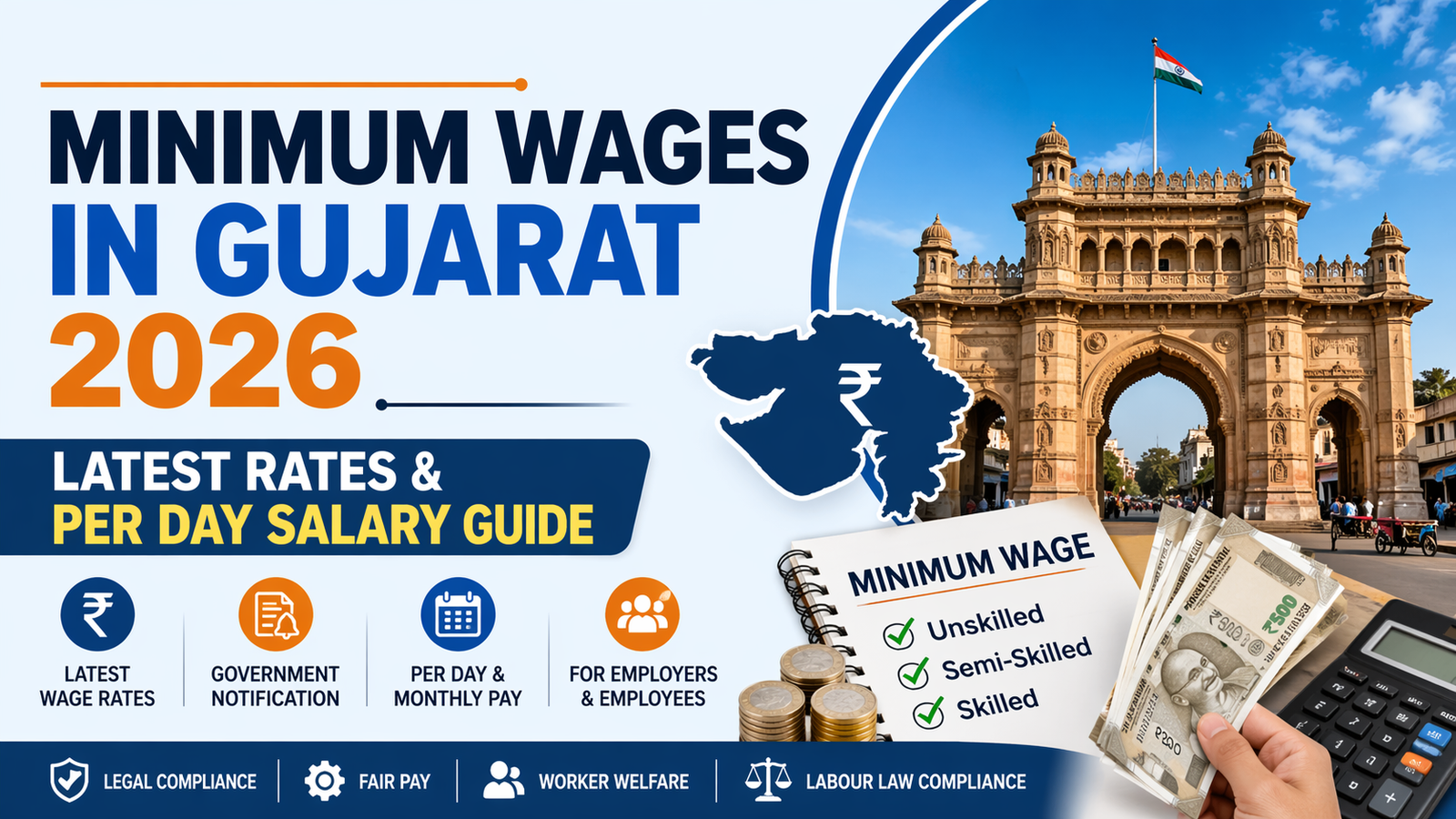
If you are an employer, HR professional, or employee, understanding the minimum wages in Gujarat is essential for compliance and fair pay. With the latest revisions for 2026, the Gujarat government has updated wage structures through official notifications.

To make payroll easier, you can use a free payslip generator to quickly create accurate and compliant salary slips.

In this guide, we’ll cover the latest minimum wages in Gujarat 2026, daily wage rates, zone-wise classification, and everything you need to know in a simple and practical format.

What Are Minimum Wages?

Minimum wages are the legally mandated lowest wages that must be paid to workers. These are defined under Indian labor laws to protect employees from underpayment.

In Gujarat, wage rates are revised periodically through official minimum wages notifications, ensuring they align with inflation and cost of living.

What are Latest Minimum Wages in Gujarat 2026?

The minimum wages in Gujarat for 2026 are based on:

  • Skill level (Unskilled, Semi-skilled, Skilled)
  • Geographic zone (Zone 1 & Zone 2)
  • Dearness Allowance (DA)

Zone Classification

  • Zone 1: Urban areas (municipal corporations, major cities)
  • Zone 2: Rural and semi-urban areas

Minimum Wage Rates (April 2026 Notification)

Here are the latest minimum wage rates based on the most recent update:

Skill Category Zone 1 (Urban) – Per Day Zone 2 (Rural) – Per Day Monthly (Approx.)
Unskilled ₹512 ₹501 ₹13,026 – ₹13,312
Semi-Skilled ₹522 ₹511 ₹13,286 – ₹13,572
Skilled ₹534 ₹523 ₹13,598 – ₹13,884

Zone 1 (Urban Areas)

  • Unskilled workers: ₹512 per day
  • Semi-skilled workers: ₹522 per day
  • Skilled workers: ₹534 per day

Zone 2 (Rural Areas)

  • Unskilled workers: ₹501 per day (approx.)
  • Semi-skilled workers: ₹511 per day (approx.)
  • Skilled workers: ₹523 per day (approx.)

👉 These figures reflect the minimum wages in Gujarat per day, which are widely used in payroll and contract labor calculations.

Note: A free payslip generator can help you easily create accurate salary slips based on the latest minimum wage rates in Gujarat. It ensures proper calculation of daily wages, DA, and compliance with current labour laws without any manual errors.

Dearness Allowance (DA) in 2026

An important component of wage calculation is the Dearness Allowance (DA).

  • DA in 2026: ₹60.5 per day
Component Amount
DA Per Day ₹60.5
Applicable From April 2026
Included In Wages Yes

This is added to the base wage and revised regularly. Any minimum wages notification issued by the government includes updated DA values.

Monthly Minimum Wages in Gujarat

To calculate monthly salary:

Monthly Wage = Daily Wage × 26 working days

Example:

  • ₹512 × 26 = ₹13,312 (Unskilled, Zone 1)
  • ₹534 × 26 = ₹13,884 (Skilled, Zone 1)

So, the minimum wages in Gujarat in 2026 generally range between:

  • ₹13,000 to ₹14,000+ per month depending on skill level

Want to create payslips based on Gujarat’s latest minimum wages?

Use our free payslip generator to quickly calculate wages and generate accurate, compliant salary slips in minutes.

Generate Your Salary Slip   

Minimum Wages in Gujarat Latest Notification

The gujarat minimum wages latest notification (effective April 2026) includes:

  • Revised daily wage rates
  • Updated DA (₹60.5/day)
  • Zone-wise classification
  • Applicability across industries

Employers must follow these rates strictly to remain compliant with labor laws.

Minimum Wages in Gujarat Per Day: Why It Matters

The concept of minimum wages in Gujarat per day is especially important for:

  • Construction workers
  • Contract labor
  • Daily wage earners
  • Small business payroll

Daily rates help ensure transparency and accurate wage calculation.

Universal Minimum Wage Law (India Context)

India has been moving toward a Universal Minimum Wage Law, also known as a national floor wage system.

While states like Gujarat set their own wage rates, the central government defines a baseline to:

  • Reduce wage inequality
  • Ensure fair income across states
  • Standardize labor practices

However, Gujarat’s wage rates are typically higher than the national floor wage.

Employer Compliance in Gujarat

If you are an employer, you must:

  • Pay at least the minimum wages in Gujarat for 2026
  • Follow the latest minimum wages notification
  • Maintain salary records and payslips
  • Update wages after every revision

Failure to comply can result in penalties and legal consequences.

Importance of Accurate Payroll Management

Managing wages manually can lead to errors. Using a payslip generator helps:

  • Calculate salaries based on latest wage rates
  • Include DA and deductions correctly
  • Maintain compliance with labor laws
  • Generate professional salary slips instantly

This is especially useful for businesses handling multiple employees.

Final Thoughts

The latest minimum wages in Gujarat 2026 reflect the government’s effort to ensure fair compensation across industries. Whether you’re calculating minimum wages per day or reviewing the latest notification, staying updated is crucial.

Accurate wage payment not only ensures legal compliance but also builds trust and stability in the workforce.

FAQs

1. What are the minimum wages in Gujarat in 2026?

They range from approximately ₹501 to ₹534 per day depending on skill level and zone.

2. What is the DA in Gujarat for 2026?

The Dearness Allowance is ₹60.5 per day.

3. How are minimum wages calculated monthly?

Daily wage × 26 working days.

4. Are minimum wages the same across Gujarat?

No, they vary based on Zone 1 (urban) and Zone 2 (rural).

5. What is the latest minimum wages notification in Gujarat?

The latest notification is issued by the Gujarat Labour Department and outlines revised minimum wage rates for different categories of workers. It also includes updates to Variable Dearness Allowance (VDA) and is legally binding on employers in scheduled employment across Gujarat.

What is the Gratuity Form: Everything You Need to Know (2026 Guide)

Gratuity Form is a financial reward that is paid to the employee who has rendered services for at least five years with the same employer. Most people don’t think about gratuity until the moment they really need it, the day they resign, or face challenging circumstances.

This guide on gratuity will be your helping hand, and when everything suddenly feels important: How do I claim my gratuity? That’s where this blog steps in to rescue you. Follow this guide to know more about the form. If you are looking for a convenient tool to create your payslips, use the free payslip generator.

What is Gratuity?

Gratuity is a statutory benefit, which means that the employer is legally responsible for paying it once eligibility is met. A gratuity form creates official proof that this obligation exists and has been formally requested.

What is the Gratuity Act?

The Payment of Gratuity Act 1972 is the Indian Labor Law that directs employers with 10 or more employees to pay a lump sum benefit to staff upon retirement or termination after five years of service.

The Act applies to factories, plantations, railways, shops, and establishments. The Act outlines the formula of gratuity calculation and rules for payment, nomination & dispute resolution. The Payment of Gratuity Act 1972 governs the gratuity rules in India. It applies to the following:

  • All establishments with 10 or more employees
  • All employees working on salary, excluding apprentices
  • Both private & public sector workers

What is Gratuity Form?

The Gratuity Form is an official document that is prescribed under the Payment of Gratuity Act 1972, which helps employees manage their entire gratuity lifecycle from nomination to final settlement.

These forms serve 3 vital functions:

  • Identify the beneficiary
  • Initiating the gratuity request
  • Processing and releasing the payment

Types of Gratuity Forms

1- Gratuity Nomination Form (Form F)

The Gratuity Nomination Form is submitted by an employee during the course of service. It specifies who will receive gratuity in case of the death of the employee. 

2- Gratuity Application Form By Employee (Form I)

The gratuity nomination is used by a worker to formally request gratuity payments after resignation, retirement, or termination. 

3- Gratuity Application Form By Nominee (Form J)

Form J is submitted by the person formally nominated by the employee to receive the gratuity in the event of the worker’s death. This includes details such as the worker’s carrier data, date of death, enrollment reference, and the enrollee’s bank details. 

4- Gratuity Application Form – By Legal Heir (Form K)

Form K is used when a worker has not filed a gratuity enrollment size. In such cases, the legal heir of the deceased employee shall submit this form alongside the criminal files containing inheritance certificates or prison heir certificates 

5- Employer’s Notice of Gratuity Payment (Form L & M)

Forms L and M are business notices issued by the company reviewing the gratuity declaration. Form L is sent until the claim is allowed and includes the amount due and the price date. If the declaration is rejected, Form M is issued declaring the reason for the rejection. This paperwork creates a thorough report of the company’s selection and all the transparency, accountability, and criminal compliance with the gratuity settlement method.

6- Gratuity Claim Form

The Time Period Gratuity Claim Form is generally used to explain the set of prestigious forms through which gratuity is claimed, specifically Form I through the employee, Form J through the nominee, and Form K with the assistance of a delinquency heir.

Do you need Instant Salary Proof for Your Financial Needs?

Create accurate & professional payslips in minutes to support gratuity claims, loans, or income verification using our salary slip maker.

Generate Your Salary Slip  

How Gratuity is calculated?

If you are covered under the Payment of Gratuity Act, 1972, the formula is:

Gratuity = (Last Drawn Salary × 15 × Number of Years of Service) ÷ 26

  • Last Drawn Salary = Basic Salary + Dearness Allowance (DA)
  • 15 = 15 days’ salary for each completed year
  • 26 = Number of working days in a month (as per law)
  • Years of Service = Total years worked (if you worked more than 6 months in the last year, it is rounded up)

For example:

  • Last drawn salary (Basic + DA) = ₹30,000
  • Years of service = 5 years

Gratuity = (30,000 × 15 × 5) ÷ 26 = ₹86,538 (approx.)

What are the Gratuity Rules in India?

The major gratuity rules in India include the following:

  • 5 years of continuous service is mandatory, unless in the event of death or disability.
  • 15 days’ wages are paid for every completed year of service.
  • The wage considered includes basic salary + dearness allowance only.
  • The gratuity amount must be paid within 30 days from the date it becomes payable.
  • Non-payment within time attracts interest and penalties.

What is Gratuity Eligibility in India?

You are eligible for gratuity under the following circumstances:

  • You have 5 years of continuous service with the employer.
  • You work at an organization that is covered under the Act.
  • You leave due to retirement or termination.

4 years + 240 days rule: In line with Madras High Court interpretation and Section 2A, 240 days of operation in the 5th yr is regularly treated as completion of 5 years of non-stop carrier, making the employee eligible.

Death or Disability: The five-12 month condition is completely waived. Gratuity is payable even if the worker has worked for several months. The nominees or the heirs of the prisoner receive the amount.

What is I form?

Form I is a compulsory paper as per the Payment of Gratuity Act, 1972. It is an instrument through which Indian workers place their official request for a gratuity amount, discharge on resignation, retirement, or disablement after the employee has completed 5 years of continuous service. Form I is a formal demand for gratuity payment made to the employer in order to start the payment procedure and is generally submitted within 30 days from the time the payment was due.

Is 4 Years 7 Months Eligible for Gratuity?

Yes, 4 years and 7 months of service is generally considered eligible for gratuity in India because many courts have interpreted that if an employee completes more than 4 years and 6 months of continuous service (i.e., at least 240 days in the fifth year), it can be rounded off to 5 years under the Payment of Gratuity Act, 1972; however, since this interpretation is based on judicial rulings and not explicitly stated in the law, eligibility may still depend on the employer’s policy, with some companies strictly requiring a full 5 years.

Key Takeaways 

A gratuity form is a crucial document that ensures employees receive the gratuity they have rightfully earned after completing their service. It acts as a formal request and verification tool, helping both employers and employees follow a structured and compliant process under the Payment of Gratuity Act. 


By understanding the purpose, types, and filing process of a gratuity form, employees can avoid delays and ensure smooth claim settlement, while employers can maintain transparency and legal compliance. In short, knowing how gratuity forms work not only simplifies the final settlement process but also protects the financial rights of employees at the end of their employment journey.

FAQs

1- What is gratuity meaning?

Gratuity means something given voluntarily or beyond obligation, usually for some service.


2- What is the payment of gratuity act?

The Payment of Gratuity Act, 1972, is an Indian labor law that mandates employers with 10 or more employees to pay a lump-sum benefit to staff upon retirement, resignation, or termination after at least five years of continuous service 


3- What is gratuity amount?

A gratuity amount is a lump-sum payment an employer gives to an employee as a token of appreciation for long-term service (usually 5+ years) upon retirement, resignation, or death 


4- What is the gratuity meaning in salary?

A gratuity is a statutory, lump-sum financial benefit paid to a worker as a thank you for a long-term provider through an agency, usually after a non-stop provider of at least five years ceases or resigns


5- Who is eligible for gratuity form?

Employees with continuous five years of service and who are employing 10 or more people are eligible for gratuity form.


6- Is Form F and gratuity form the same?

Yes, Form F is the specific statutory gratuity nomination shape under the Payment of Gratuity Act, 1972, which is used by personnel to nominate beneficiaries for taking gratuity in case of death.


7- How can I get my gratuity amount?

To receive your gratuity amount, you need to have completed at least 5 years of continuous provider and work for an enterprise with 10+ employees.


8- Is 4 years 7 months eligible for gratuity?

An employee with 4 years and 7 months of service is generally not automatically eligible for gratuity, as the Payment of Gratuity Act, 1972 requires five continuous years


9- What is Form C in gratuity?

Form C under the Payment of Gratuity (Central) Rules, 1972, is a mandatory Notice of Closure submitted by an employer to the controlling authority.


10- Will I lose gratuity if I resign?

No, you will not lose your gratuity if you resign.

What is LWD in Job? Everything You Need to Know (2026)

Last Working Day (LWD) refers to the last day an employee is physically present at the work premises. Typically, the LWD is the day when an employee may not be physically present at the work premises but still serves the notice period. In the coming years, due to changing work patterns, remote jobs, and flexible working arrangements, the notion of LWD will be more relevant and significant for employees and employers.

Create compliant payslips in minutes with our payslip generator. Simple to use, fast to generate, and designed to deliver 100% professional results every time.

In this blog, we will help you understand what LWD means in a job, its importance, how to calculate it, and what you need to consider before your LWD.

What is LWD in job?

 LWD stands for Last Working Day; it is the final working day that an employee works for a company. It is determined by the notice period after resignation or termination. It marks the end of salary, benefits, and the official exit from the company.

What is the Relieving Date in LWD?

Relieving date in LWD means the final day you officially leave your job and are relieved from all duties by the company.

How is LWD calculated?

The calculation of is done by adding the required LWD in notice period to the date till the employer accepts the resignation.

Formula

LWD = Resignation Acceptance Date + Notice Period Duration (in Days).

This duration allows for proper handover and transfer of responsibilities, including weekends, unless specified in the policy.

Factors influencing the LWD

  • Company Policy: Standard notice periods are of 30, 60, or 90 days.
  • Leave Balance: Employees should use PL or other accrued leaves to reduce the working days during work time.
  • Notice Period Buyout: Employers may compensate the employee so that they do not leave before the required notice period.
  • Managerial Direction: Early release may be approved if the employee finishes knowledge transfer, such as exit interviews.

Example: 30-Day Notice Period

Resignation accepted: 1 July 2026

Notice period: 30 days

LWD: 30 July 2026

Important Notes to Remember
  • Weekends and holidays are included in the notice period unless it’s written in the company policy.
  • Check your appointment letter as rules might differ by the organisation.
  • Using the leave option can adjust the LWD but might affect the timing of F&F settlement.

Why is LWD important?

The Last Working Day (LWD) is important because it marks the criminal abandonment of employment and allows each company and employee to easily issue related work.

For Employees

  • LWD sets the full and final settlement payout date that covers dues like unpaid salary and benefits.
  • New employers require an experience letter dated to this day for verification.
  • It directly impacts the joining date of the following organization, serving as proof of an earlier employment end date.

For Employers

  • LWD acts as the deadline for recovering assets like laptops.
  • It sets the timeline for restricting IT access and complete security handovers.
  • Payroll processing cuts off till this date, which enables accurate final calculations.  

What does LWD meaning in HR?

LWD meaning in HR refers to the final date of working when an employee is officially considered on the payroll and is required to work or remain available for handover.

Importance of LWD in Job

The following are the importance of LWD in a job:

For HR

  • It helps in finalizing the settlements.
  • It is based on experience and reference letters.
  • Keys for audit records.

For Employees

  • Proof of employment end date for joining a new job.
  • It is required for background verification.
  • Essential for financial documentation.

For Companies

  • Make sure there is a smooth transfer.
  • Allows planning for backfill hiring.
  • Prevents disruption in projects.

LWD checklist: What to do on your last day?

  • Handover: Make a detailed summary of ongoing tasks and important contacts. Ensure that all the responsibilities are properly assigned and that no pending work is left unassigned.
  • Asset return: Return all office equipment, like laptops and ID cards.
  • Exit Interview: Be honest while sharing your experience and feedback.
  • Wipe out data: Backup personal files from the company device.
  • Farewell email: Write a farewell email to your colleague for their shared support and experiences.

Need help understanding your LWD or payslip details?

Use our free payslip generator to create accurate, professional paystubs in minutes and simplify your HR documentation.

Generate Your Salary Slip  

How is LWD determined?

LWD is determined based on the notice period policy and termination date. Below we have shown the figures:

LWD based on Notice Period Policy

Most companies calculate LWD by adding the notice period to the resignation acceptance date. 

Example:

  • Resignation submitted: 1st June 2026
  • Notice Period: 30 days
  • LWD = 30th June 2026

Case of Termination

If an employee is being terminated, the LWD becomes the immediate date of termination, until and unless the employer provides a garden leave.

Garden & Forced Leave

In high-security roles, employees might be asked to stay away from the office during the notice period but remain on payroll.

LWD vs Resignation: Major Differences

Factors LWD Resignation
Definition Final date on the employee’s work for the company. The date on which an employee submits their resignation letter to the employer.
Purpose Begins the resignation & notice period process. Marks the end of employment and completion of notice period.
Who decides it? Employer + Employee. Employee.
Timing Always equal to resignation date. Always before the LWD.
Exit formalities Indicates the completion of all exit tasks. Triggers handovers and HR processes.

Key Takeaways

In the process, the LWD needs to understand that exit techniques do not lead to disputes all the time. It affects your entire and final agreement, alleviation of papers, subscribing to formalities, and the new process. If you are a worker, continue to clear your LWD with HR in writing. Clear communication for HR teams ensures a smooth exit and stops conflicts.

FAQs

1- What is LWD in salary slip?

LWD is the final date an employee officially works for a company. It is determined by the notice period after a resignation.

2- What is LWD when applying for a job?

In HR terms, LWD stands for last working day. It shows the final date of an employee who was officially working for the company.

3- Should I give 2 weeks’ notice or 4?

Most employers expect a notice of two weeks or more. 

4- Can HR hold salary after resignation?

Employers cannot legally withhold salary without any valid justification.

5- Which leaves are paid after resignation?

The privilege leave is accrued. Employees can carry forward unused leave for up to 45 days and cash in any accumulated leave upon resignation.

6- Can I get final pay if I resign?

Resigning employees are only entitled to separation pay if the company policy allows it.

7- Can I resign and give 3 months’ notice?

If you are considering quitting your current job, it is necessary to give a three-month notice period. 

8- What is the 30 60 90 rule for new jobs?

A 30 60 90 plan is a structured roadmap that breaks down a new hire’s first three months into a goal-driven phase.

9- Can I encash all my leaves?

Yes, you can encash all of your leaves, as many firms allow it during the time of exit.

10- What are the red flags at a new job?

When the salary is lower than the industry standard, or it is below your worth, and there is no benefit package to make up for it.

11- What is LWD full form in HR?

LWD full form in HR is Last Working Day. It is referred to as the final day an employee works for a company before finally leaving the job.

What is LWF in PaySlip? Meaning, Deduction & Calculation

If you have ever glanced at your monthly salary slip and noticed a small deduction labelled LWF and wondered what it means, you are not alone. Thousands of employees across India ask the same question every month: What is LWF in the payslip? The answer, while rooted in labour law, is both simple and important to understand as a working professional.

LWF stands for Labour Welfare Fund, a statutory, state-government-managed, contributory scheme designed to improve the quality of life for workers in India’s organised sector. It is one of several deductions you will find on a salary slip alongside PF, ESI, and Professional Tax. If you need a professional Salary Slip Generator for your business, you can use our tool.

This comprehensive guide will explain what LWF is in my payslip, what the LWF rate is in my payslip, from a legal perspective, how it is calculated, which states enforce it, and what benefits you are entitled to under the Labour Welfare Fund scheme, all updated to reflect the latest 2025–26 regulatory changes.

What is LWF in Payslip? 

LWF’s full form is Labour Welfare Fund. When you see LWF as a deduction line item on your monthly salary slip or payslip, it represents the amount your employer has deducted from your wages as your contribution towards the state-government-managed Labour Welfare Fund.

The Labour Welfare Fund is a statutory contributory fund constituted by individual state governments in India to provide welfare services and socio-economic support to workers in the organised sector. It was conceptually introduced under the broader ambit of the Industrial Disputes Act of 1947, which sought to improve labourers’ working conditions and standards of living. Over subsequent decades, various state legislatures enacted their own dedicated Labour Welfare Fund Acts to operationalise the scheme.

Who is Eligible for LWF? 

LWF eligibility applies to employees, including manual, skilled, and unskilled, and contract workers who are earning below a particular wage threshold, which is set by the individual Indian state laws.

Who is Covered Under LWF?

The Labour Welfare Fund applies broadly to employees working in organisations covered under their respective state’s LWF Act. Generally, the fund covers:

  • Factory workers and industrial labour in manufacturing establishments
  • Employees of commercial establishments and shops covered under the respective Shop and Establishment Act
  • Workers employed by transport services, construction companies, plantation estates, and registered societies
  • Contract workers and those engaged through principal employers in covered industries
  • Both permanent and temporary employees within the wage threshold set by the state

Who is Exempt from LWF?

Certain categories of workers are generally exempt from LWF deductions, though the exact criteria vary by state:

  • Employees working in a managerial or supervisory capacity and earning above a specified wage threshold
  • Part-time employees (in most states)
  • Apprentices and trainees (in most states)
  • Employees engaged in establishments below the minimum employee threshold set by the state

Minimum Employee Threshold by State

Establishments are covered under the LWF Act only if they meet a minimum employee count. Key thresholds as of 2026 include:

Minimum Employee Required States
1 or more Madhya Pradesh, Chhattisgarh
5 or more Delhi, Maharashtra, Tamil Nadu
10 or more Haryana, West Bengal
20 or more Andhra Pradesh

Karnataka’s threshold was reduced from 50 to 10 employees following the Karnataka LWF Amendment Act, 2025, effective January 7, 2026.

How is LWF Calculated in Your Payslip?

Understanding how LWF is calculated helps employees verify whether the deduction appearing on their salary slip is accurate. Unlike PF, LWF contributions are largely flat amounts in most states, making the calculation straightforward.

Step-by-Step Calculation Example

Scenario: An employee working in Pune, Maharashtra, with a monthly gross salary of ₹45,000.

  • State applicable: Maharashtra
  • Deduction frequency: Half-yearly
  • Employee contribution: ₹25 per half-year
  • Employer contribution: ₹75 per half-year
  • Total combined LWF contribution: ₹100 per half-year

On the employee’s June payslip, the LWF deduction line will show ₹25, a small but legally mandated deduction. The employer will add their ₹75 share separately and remit a total of ₹100 to the Maharashtra Labour Welfare Board by July 15.

Benefits of the Labour Welfare Fund: What Do You Get?

Benefits of the Labour Welfare Fund What Do You Get

Now that you understand what the labour welfare fund is in my payslip generator from a deduction standpoint, let us focus on what you actually receive in return for your contribution. The Labour Welfare Fund is design to improve the overall quality of life for workers and their dependents through a range of welfare schemes administer by the State Labour Welfare Board.

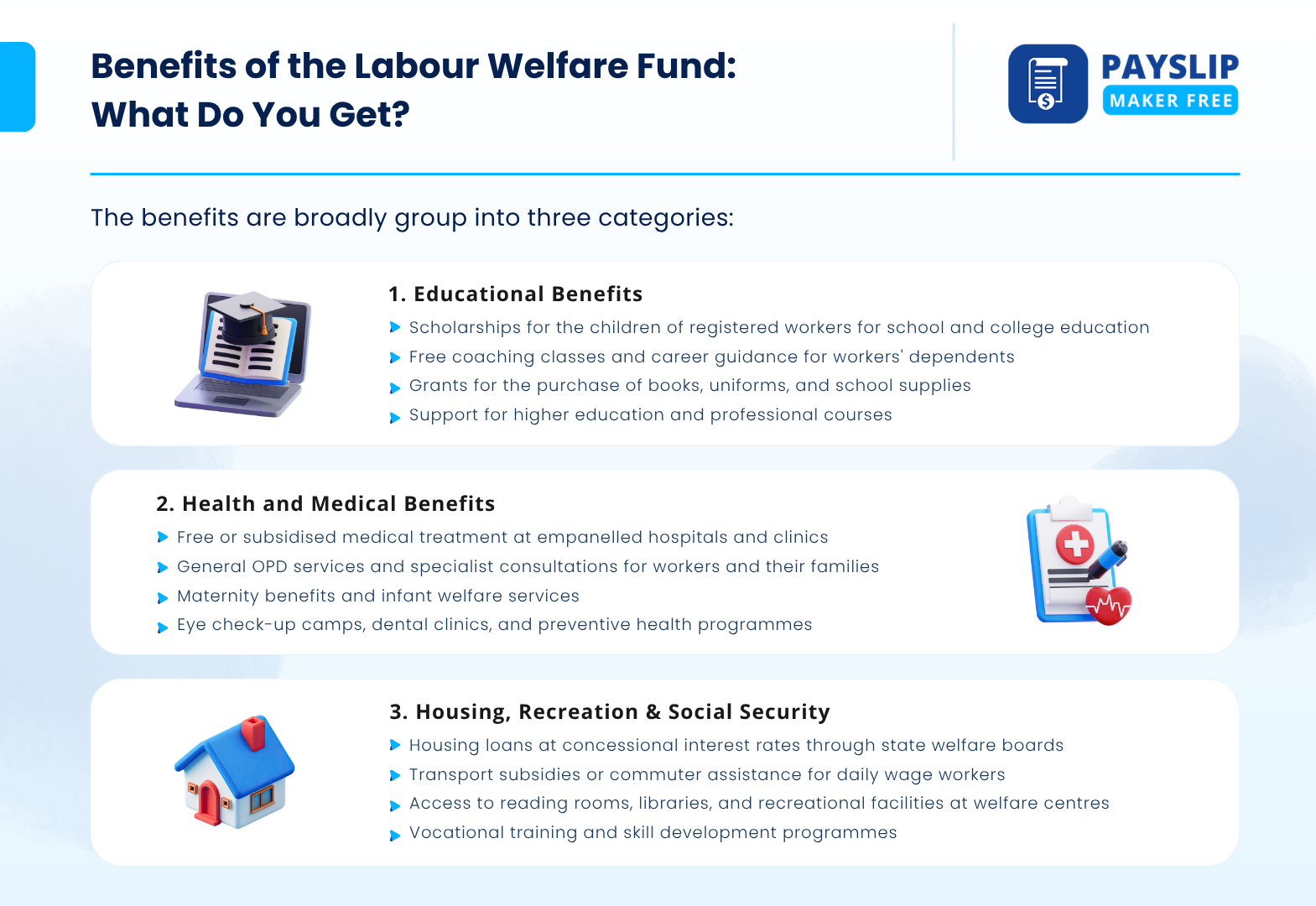
The benefits are broadly group into three categories:

Category 1: Educational Benefits

  • Scholarships for the children of registered workers for school and college education
  • Free coaching classes and career guidance for workers’ dependents
  • Grants for the purchase of books, uniforms, and school supplies
  • Support for higher education and professional courses

Category 2: Health and Medical Benefits

  • Free or subsidised medical treatment at empanelled hospitals and clinics
  • General OPD services and specialist consultations for workers and their families
  • Maternity benefits and infant welfare services
  • Eye check-up camps, dental clinics, and preventive health programmes
  • Medical assistance for critical illnesses in select states

Category 3: Housing, Recreation & Social Security

  • Housing loans at concessional interest rates through state welfare boards
  • Transport subsidies or commuter assistance for daily wage workers
  • Access to reading rooms, libraries, and recreational facilities at welfare centres
  • Vocational training and skill development programmes
  • Marriage assistance grants for the daughters of workers (in select states)
  • Funeral assistance and death benefits for the family of deceased workers
  • Excursions and cultural activities for workers and their families

The exact benefits available to you depend on your state’s Labour Welfare Board and the specific schemes they have launched. Employees can typically access these benefits by registering as a beneficiary with the State Labour Welfare Board and submitting the required documentation.

How to Identify LWF on Your Payslip?

When you receive your monthly salary pay slip online, the LWF deduction will typically appear under the deductions section. Depending on your employer’s payroll software and formatting, it may be labelle as:

  • LWF
  • Labour Welfare Fund
  • LWF Contribution
  • L.W.F. Deduction

As you can see, LWF is typically the smallest deduction on your payslip. However, its presence is legally required, and the employer must remit the combined employee and employer share to the Labour Welfare Board within the stipulated deadline.

Confused about deductions like LWF in your salary slip?

Create accurate, professional payslips in seconds with our easy-to-use tool.

Generate Your Salary Slip  

Employer Responsibilities Under the LWF Act

Understanding the employer’s obligations under the LWF scheme gives employees a clearer picture of how the entire system works and helps them hold employers accountable.

Under the Labour Welfare Fund Act, employers are legally obligated to:

  • Register the establishment with the State Labour Welfare Board within 15 days of commencement
  • Deduct the employee’s LWF contribution from their monthly wages in accordance with state-specific rates
  • Add the employer’s own contribution
  • Remit the combined total to the State Labour Welfare Board before the applicable deadline
  • File annual returns and maintain proper LWF records as required by the state government
  • Display notices and communicate LWF deduction information to employees

Non-compliance with LWF obligations can result in penalties, fines, and prosecution under the respective state’s Labour Welfare Fund Act. The penalties vary by state but can significantly exceed the original contribution amounts, making timely compliance a critical priority for employers.

Is LWF Deduction Tax-Deductible?

This is another commonly ask question. LWF contributions made by employees are not explicitly list under Section 80C of the Income Tax Act as deductible investments. However, they form part of your overall cost-to-company structure and reduce your taxable take-home income marginally, since they reduce your gross pay.

Employer contributions to the Labour Welfare Fund are treat as a business expense and are generally deductible for the employer under the Income Tax Act. From the employee’s perspective, the LWF contribution is a statutory deduction like Professional Tax and is not separately claimable as a deduction while filing your income tax return.

How to Check and Claim LWF Benefits?

Many employees contribute to LWF for years without ever claiming the benefits they are entitle to. Here is how you can access the welfare schemes under the Labour Welfare Fund:

Step 1: Confirm Your State’s LWF Applicability

Verify that your state has an operative LWF Act (refer to the table in Section 2). If you work in a state without LWF legislation, you are not eligible for these benefits.

Step 2: Register with the State Labour Welfare Board

Visit your state’s official Labour Welfare Board website or office. Submit the required documents, typically including your Aadhaar card, employee ID, salary slip showing LWF deduction, employer registration details, and bank account information.

Step 3: Apply for the Relevant Scheme

Once registered as a beneficiary, browse the available welfare schemes on the board’s website or enquire at their office. Submit the relevant application form with supporting documents for the specific benefit, whether it is an education scholarship, medical assistance, or housing loan.

Step 4: Follow Up and Track Status

Most state Labour Welfare Boards now offer online portals for benefit tracking. Keep your registration number handy and follow up if you do not receive a response within the stipulated timeframe.

Common Misconceptions About LWF

LWF is deducted every month from everyone’s salary: False. In most states, LWF is deducted half-yearly or annually. Monthly deductions apply only in states like Haryana, Punjab, and Delhi.

WF and ESI are the same thing: False. ESI is a central government scheme providing medical insurance to employees earning up to ₹21,000 per month. This is a separate, state-government-managed scheme with different benefits, rates, and applicability.

LWF is a huge deduction that significantly reduces take-home pay: False. This contributions are among the smallest statutory deductions. For example, in Gujarat, the annual employee contribution is just ₹12. Even in states with higher contributions like Maharashtra, the impact on take-home pay is minimal.

If I change jobs, I lose my LWF contributions: Partially true. Unlike PF, there is no universal LWF account portability. However, the benefits funded by LWF are accessible to any eligible employee registered with the State Labour Welfare Board, not tied to a specific employer.

All employees in India are subject to LWF: False. Only employees working in establishments in states with operative LWF legislation, and meeting the applicable employee count and wage thresholds, are subject to LWF deductions.

FAQs

1) What is the LWF in the salary slip?

LWF in the salary slip stands for Labour Welfare Fund, a compulsory deduction from an employee’s salary in India.

2) What is the labour welfare fund in my payslip?

The Labour Welfare Fund in my payslip stands for a mandatory deduction from employee salaries in various states to fund Social Security, Medicare, and housing for workers.

3) Why is LWF deducted from my salary?

LWF is deducte from my salary because it is use to fund social security and raise living standards for employees.

4) What are the benefits of using LWF?

LWF promises services which range from scholarships for workers’ children to healthcare subsidies and recreational facilities.

5) How many times is LWF deducted?

LWF is deducte annually, half-yearly, or monthly.

Key Takeaways

Knowing what LWF in payslip is is not just about satisfying curiosity over a small deduction line, it is about understanding your rights and entitlements as a working professional in India. The Labour Welfare Fund, though modest in its contribution amounts, is part of a broader statutory framework design to provide meaningful social security, healthcare, and educational support to the country’s organise workforce.

How to Make a Salary Slip Template for Your Company?

Each salaried employee has the right to know where their hard-earned money is going, and every employer is responsible for legally obligated to make sure it happens. Startups and small business owners issue informal payslips that lack critical details and risk non-compliance with the Indian Labour Law.

Whether you’re an HR professional who is setting up payroll for the first time or are looking to modernise your compensation documentation, this guide covers everything right from how to make a salary slip to a payslip format that is easy to understand.

What is a Salary Slip?

A salary slip is an official document issued by an employer that shows an employee’s earnings, deductions, and net pay for a specific month. It is used for tax filing, loan applications, and employment verification.

Why is a Salary Slip Important for Employees & Employers?

For employees:

  • Proof of income for loan and credit card applications
  • Vital documentation for income tax filing 
  • Evidence of employment during background verification
  • Supporting documents for visa applications

For employers:

  • Showcase payroll transparency and build employee trust
  • Pass statutory audits 
  • Maintain accurate records mandated under Indian Labour Laws

What is a salary payslip template?

A salary payslip template is a fixed format that is used to create an employee slip using payslip generator every month. This template decides what appears on a salary slip, where it should appear, and how earnings and deductions are shown.

Key Components of a Salary Slip Template

A typical payslip format is divided into three main sections:

1) Company Details

  • Company name
  • Address
  • Logo
  • Contact details

2) Employee Information

  • Employee name
  • Employee ID
  • Designation
  • PAN / Aadhar
  • Bank details

3) Pay Period Details

  • Salary per month
  • Working days
  • Leave details

4) Earnings Section

  • Basic salary
  • House rent allowance
  • Conveyance allowance
  • Medical allowance
  • Special allowance

5) Deductions Section

  • Provident fund
  • Professional tax
  • Income tax

6) Net Salary

This is the final take-home pay.

7) Additional Details

  • PF number
  • Payment mode
  • Employer signature

Do you need a professional payslip in minutes?

Create your salary slip instantly using our free payslip generator—no signup required.

Generate Your Salary Slip   

How to make a Salary Slip?: Step-by-Step Guide

Now that you understand the components, here is a practical, step-by-step walkthrough on how to create salary slip documents for your company, whether you have five employees or five hundred.

Step 1: Choose your Tool

You can create a template by visiting:

A reliable payslip generator 

Step 2: Add Payslip Details

  • Payslip number
  • Date
  • Choose template 

Step 3: Insert Company Details

  • Company Logo
  • Company Name
  • Company Address
  • Company Phone Number
  • Company Email ID
  • Additional Company Information

Step 4: Add Employee Details

  • Employee Name
  • Date of joining
  • Employee code
  • Department
  • Designation
  • Phone Number
  • Address
  • Email ID
  • Additional Email Information

Step 5: Basic Details

  • Pay Period
  • Working Days
  • Payment Mode

Step 6: Bank Details

  • Bank Name
  • Account Number

Step 7: Salary Details

  • Earnings
  • Amount
  • Deductions
  • Amount

Step 8: Net Pay

  • Gross Earnings – Deductions 
  • Amount in Words

Step 9: Signature

  • Upload Signature

Step 10: Preview & Download

  • Click the preview button and download the payslip

Why does your company need a Salary Slip Model?

It is important to understand why a simple salary slip format is important:

1- Legal Compliance: Labour laws require employers to provide salary slips.

2- Payroll Accuracy: A template reduces human errors and ensures consistency is maintained.

3- Employee Transparency: Employees can clearly understand their earnings, deductions, and net pay.

4- Financial Documentation: A salary slip is required for loans, credit cards, and visa applications.

Best Practices for Creating a Salary Slip

1- Keep it Simple: A simple Salary Slip Model improves employees’ readability.

2- Maintain Consistency: Use the salary slip template across all employees.

3- Ensure Accuracy: Double-check calculations before issuing.

4- Use Digital Payslips: Email slips are faster.

How can small business owners create payslips easily?

If you’re a small business owner who needs to create a simple format, follow these steps:

  • Use a professional and trustworthy salary slip generator like Payslip Maker Free
  • Make your salary slip model scalable
  • Keep your salary slip template updated

Key Takeaways

From selecting the right payslip format to ensuring every statutory deduction is correctly computed, every detail matters. Whether you start with a simple format in a reliable payslip tool that auto-generates payslips, the goal remains the same: ensure every employee receives a clear, accurate, and legally compliant pay statement every single month. Whether you are learning how to make a salary slip for the first time or upgrading your system, following a structured approach will save time and reduce errors.

Also check:

Is There an SSN Number in India? Everything You Need to Know

Form 24Q (Quarterly TDS Return): Meaning & Deadlines 2026

Minimum Wages in Gujarat 2026: Latest Rates & Per Day Salary Guide

What is the Gratuity Form: Everything You Need to Know (2026 Guide)

What is LWD in Job? Everything You Need to Know (2026)

FAQs

1) How do I create my own payslip?

To create your own payslip, include company and employee details, list earnings and deductions, calculate gross and net salary, and format it using Excel, Word, or a payslip generator.

2) What is a salary slip template?

A salary slip template is a document that is provided by an employer to an employee, highlighting their earnings and deductions for a particular pay period.

3) How to create a simple payslip?

You should include the employee’s name, company name, payslip details, bank details, and salary details, and hit the generate button.

4) How to get a digital payslip?

Payslips can be delivered in the postal system or electronic format. Payslips are issued in paper format to each payee’s postal address.

5) How to format a payslip?

Generate a professional payslip with the help of a Payslip Maker Free, including the employee’s name, company name, payslip details, bank details, and salary details.

6) What is a dummy payslip?

A dummy payslip helps you see how your salary, deductions, benefits, and taxes will reflect in your take-home pay.

7) Is a 70,000 salary good in India?

Yes, 70,000 per month is considered a good and above-average salary in India.

8) Does HR verify the salary slip?

Yes, the HR department verifies the payslip by checking their backgrounds and verifying salary slips to confirm an employee’s income and their history.

9) How to spot a fake payslip?

You can spot a fake payslip by checking for inconsistencies in formatting, unusual fonts, and missing tax deduction details.

10) Who generate payslips?

Payslips are generated by the employer, usually through the HR or payroll department.