
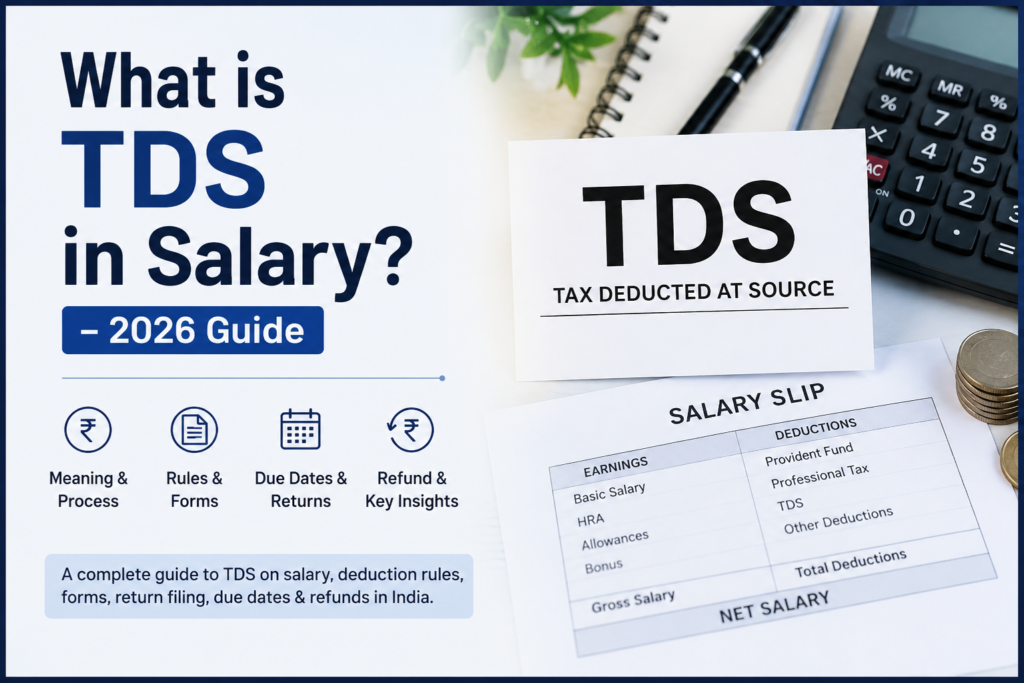
If you are a salaried employee in India, you have probably noticed a deduction called TDS in your salary slip. Many employees wonder: what is TDS in salary, why is it deducted every month, and how does it affect take-home salary?
In simple words, TDS helps the government collect income tax directly from your salary before the money reaches your bank account. Employers deduct a certain amount based on your estimated annual income and deposit it with the Income Tax Department.
Understanding TDS details in your salary slip is important for managing taxes, checking deductions, and maintaining accurate payroll records with a salary slip generator.
What is TDS?
TDS is a tax collection mechanism that was introduced by the Income Tax Department to make sure regular and timely tax collection. Instead of waiting for taxpayers to pay tax at the end of the year, the government collects tax throughout the year.
TDS applies to various types of payments, which include:
- Salary
- Interest income
- Professional fees
- Rent
- Commission
- Contract payments
- Dividend income
In salary income, employers estimate your annual taxable income and deduct tax every month accordingly.
How TDS on salary work?
Below is the complete process working of salary TDS:
1- Employer estimates annual salary
- Basic pay
- Allowances
- Incentives
- Bonuses
- Perquisites
2- Deductions
Eligible deductions are adjusted as:
- Standard deduction
- Section 80C investments
- NPS contributions
- Health insurance
- Home loan interest
3- Taxable income is calculated
Taxable income = Gross salary – deductions
4- Income tax applied
The applicable tax slab under the old regime is applied.
5- Monthly TDS Deducted
The estimated annual tax liability is divided across months.
What is TDS due date?
TDS value for tax deducted between April and February is normally payable through the seventh of the next month, while the March deduction is payable by April 30. Quarterly TDS returns have to be filed using the end of the month after each filing.
What is TDS return due date?
TDS returns are normally due on the 31st of the month after the zone break, except for the March zone, which is due on May 31.
What is TDS in salary?
TDS in salary is the monthly deduction of income tax by the employer based on the employee’s taxable income and applicable tax slab. Employers calculate TDS after considering:
- Basic salary
- HRA
- Bonus
- Special allowances
- Perquisites
- Standard deduction
- Investments under Section 80C
- Home loan benefits
- Other deductions
Need Accurate & Professional Pay Stubs Without the Hassle?
Create your pay stubs online in minutes with easy-to-use templates and instant download options.
TDS Forms
The following are the TDS Forms:
-
- Form 16: The entire paid income and deducted for the duration of the monetary year was issued to the employees exhibiting TDS by the employers.
- Form 16A: Issued for TDS for deductions beyond earnings, which includes banking hobbies, fees, or specialist payments.
- Form 24Q: Quarterly TDS return filed by employers reporting tax deducted from employee salaries.
- Form 26Q: The quarterly TDS return is used to document tax deductions on bills made to residents in addition to earnings.
- Form 27Q: Quarterly TDS returns for reporting tax after deducting bills made to non-resident individuals or foreign entities.
- Form 26QB: Invoice cum statement used to deposit TDS deduction while shopping for real estate.
- Form 26QC: Challan-cum-declaration used for the deposit of TDS on the payment of rent made by individuals or HUFs under Section 194IB.
- Form 15G / 15H: Self-declaration forms submitted to banks or financial institutions to avoid TDS when income is below the taxable limit.
- Form 13: Application submitted to the Income Tax Department to request a deduction of TDS at a lower rate or nil rate.
How to file TDS return online?
Filing TDS returns online is essential for employers and agencies that deduct tax at the time of supply from workers’ wages, contractor bills, leases, or other taxable payments. The Income Tax Department calls on deductors to post TDS returns on a quarterly basis to document tax deductions and deposits. Below are simple steps:
1- Collect Required Documents
- TAN
- PAN details of employees or deductees
- Salary and deduction details
- Challan information for deposited TDS
- Form 24Q, 26Q, 27Q, or 27EQ depending on the type of deduction
2- Prepare the TDS Return
Use a free payslip generator to prepare the TDS return file. Make sure all salary details, deductions, and PAN information are accurate to avoid rejection.
3- Validate the File
After preparing the return, validate the document using the File Validation Utility (FVU). The verification method checks for errors in PAN, drive details, and deduction amount.
4- Upload the TDS Return
Visit the official Income Tax e-Filing Portal and log in using your TAN credentials.
Then:
- Go to TDS > Upload TDS
- Select the correct form type
- Choose the financial year and quarter
- Upload the validated .fvu file
- Submit the return using DSC or EVC verification
5- Check Filing Status
Once submitted, you can monitor the reputation of your TDS return from the dashboard. If custom, the status will show Processed.
TDS Deduction Rules
Understanding the TDS deduction rules is crucial for employees and employers due to:
- TAN Requirement: Employers should have a TAN.
- PAN Submission: Employees should provide PAN to avoid higher TDS deduction.
- Tax Slab-Based Deduction: Salary TDS depends on the applicable tax slab.
- Declaration of Investments: Investment proofs, rent receipts, insurance premiums receipts, and home loan statements.
- Employer must deposit TDS: The deducted amount should be deposited within the prescribed period.
- Quarterly TDS return filing: Employers must file quarterly TDS returns.
Latest TDS rules in 2026
Recent compliance trends include:
- Increased automation
- AI-based tax mismatch detection
- Faster notice generation
- Digital correction statements
- Real-time PAN verification
- Enhanced AIS integration
Key Takeaways
TDS plays an important role in our tax planning. Throughout a financial year, we interact in several transactions in which TDS deduction is mandatory. It is important to be aware of the TDS costs relevant to each transaction and to ensure timely compliance with tax and legal guidelines to avoid penalties. Moreover, with a clean understanding of our TDS liability, we can effectively plan for deductions and exemptions. This foresight reduces our TDS deduction rather than optimizing our general tax and financial savings.
FAQs
1- Is TDS refundable on salary?
Yes, tax deducted at source (TDS) on salary is refundable if the total tax deducted by your corporation exceeds your actual tax liability for the financial year. You can claim this excess amount as a refund by submitting your Income Tax Return (ITR) and providing the correct funding information.
2- What is the TDS for 50,000 salary?
For a month-to-month profit of ₹50,000 (₹6,00,000 annually), TDS is generally zero under the new tax regime due to the exemption (earnings). ₹7 lakh). Under the old tax system, if no investment is made, taxes of ₹6 lakh are rounded up to ₹32,500–₹33,800 annually, which translates to more or less ₹2, seven hundred–₹2,800 monthly, depending on exemptions.
3- Who should pay TDS on salary?
Under Section 192 of the Enterprise (Payment) Income Tax Act, it is liable to deduct tax withheld (TDS) at source on salaries when making payments to employees, provided that the earnings exceed the exemption restriction. The corporation is responsible for calculating, deducting, and depositing this tax with the authorities every month.
4- Is TDS 100% refundable?
TDS refund is applicable when the tax deducted at source (TDS) by your employer exceeds your actual tax liability for the financial year.
5- Why is TDS deducted from salary every month?
TDS (Tax Deducted at Source) is deducted from salary every month under Section 192 of the Income Tax Act to ensure a steady flow of tax revenue for the government and to prevent the burden of a large lump-sum tax payment at the end of the year.
6- Can I claim TDS after 1 year?
Yes, you can declare TDS (Tax Deducted at Source) after 1 12 months, normally up to four years, with the help of an updated Income Tax Return (ITR-U) or a revised return, provided that the corresponding benefit is suggested in that year.
7- Is TDS 2% or 5%?
Section 194IB: This section applies to persons or HUFs who are not now subject to tax audit. TDS is deducted at the rate of 2% on rent paid for land, building, or both, when the monthly rent exceeds ₹50,000.
8- What is TDS in Income Tax?
TDS is a device where the payer deducts a percentage of tax before creating bills like salary, lease, or interest, and deposits it all at once with the government on behalf of the recipient.
Also Check:
NCP Days in PF: Complete Guide with Examples & Calculation
Paid Time Off (PTO): Meaning, Benefits & How It Works
What is the Gratuity Form: Everything You Need to Know (2026 Guide)
Is There an SSN Number in India? Everything You Need to Know