
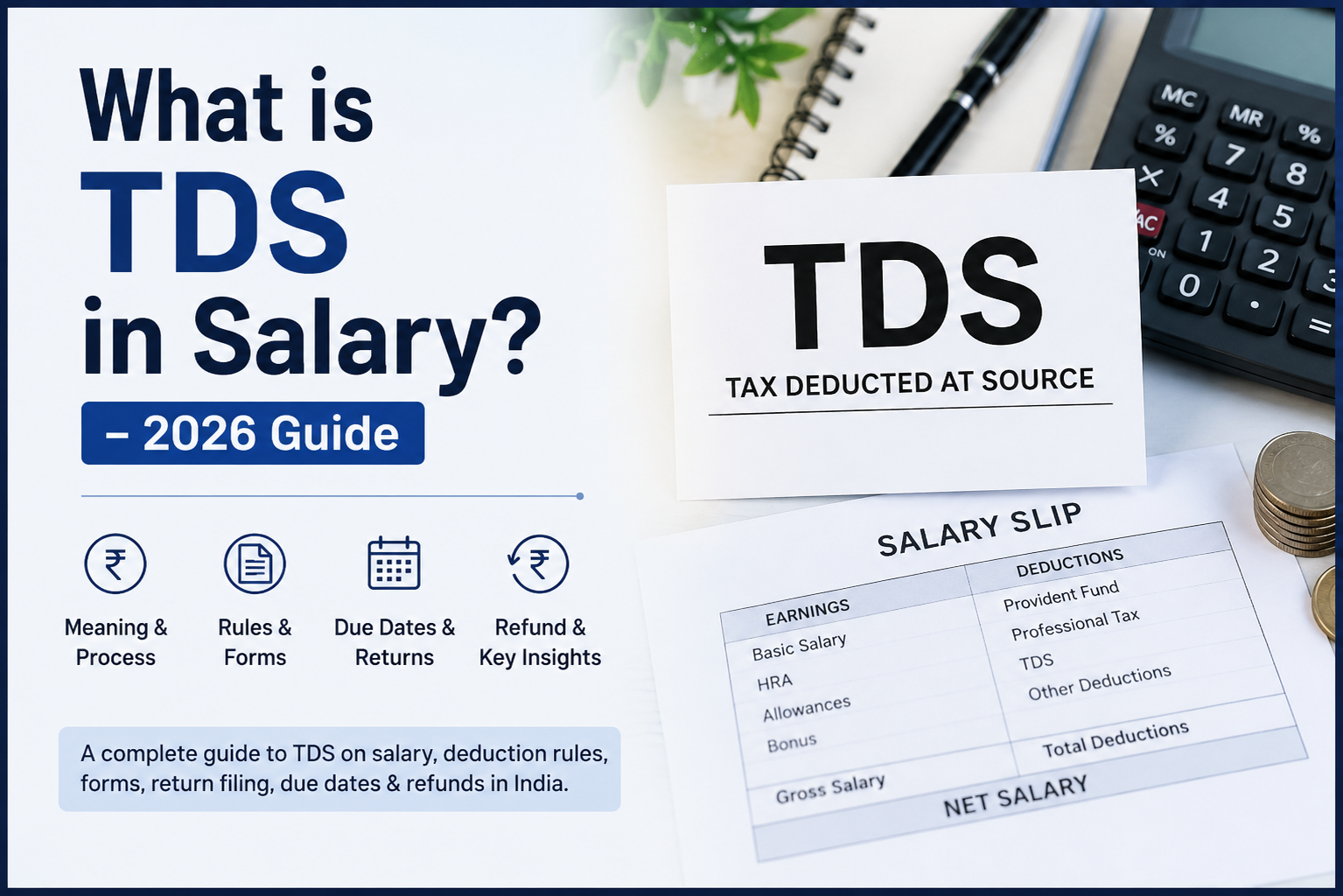
What is TDS in Salary? – 2026 Guide

If you are a salaried employee in India, you have probably noticed a deduction called TDS in your salary slip. Many employees wonder: what is TDS in salary, why is it deducted every month, and how does it affect take-home salary?

In simple words, TDS helps the government collect income tax directly from your salary before the money reaches your bank account. Employers deduct a certain amount based on your estimated annual income and deposit it with the Income Tax Department.

Understanding TDS details in your salary slip is important for managing taxes, checking deductions, and maintaining accurate payroll records with a salary slip generator.

What is TDS?

TDS is a tax collection mechanism that was introduced by the Income Tax Department to make sure regular and timely tax collection. Instead of waiting for taxpayers to pay tax at the end of the year, the government collects tax throughout the year.

TDS applies to various types of payments, which include:

  • Salary
  • Interest income
  • Professional fees
  • Rent
  • Commission
  • Contract payments
  • Dividend income

In salary income, employers estimate your annual taxable income and deduct tax every month accordingly.

How TDS on salary work?

Below is the complete process working of salary TDS:

1- Employer estimates annual salary

  • Basic pay
  • Allowances
  • Incentives
  • Bonuses
  • Perquisites

2- Deductions

Eligible deductions are adjusted as:

  • Standard deduction
  • Section 80C investments
  • NPS contributions
  • Health insurance
  • Home loan interest

3- Taxable income is calculated

Taxable income = Gross salary – deductions

4- Income tax applied 

The applicable tax slab under the old regime is applied.

5- Monthly TDS Deducted

The estimated annual tax liability is divided across months.

What is TDS due date?

TDS value for tax deducted between April and February is normally payable through the seventh of the next month, while the March deduction is payable by April 30. Quarterly TDS returns have to be filed using the end of the month after each filing.

What is TDS return due date?

TDS returns are normally due on the 31st of the month after the zone break, except for the March zone, which is due on May 31.

What is TDS in salary?

TDS in salary is the monthly deduction of income tax by the employer based on the employee’s taxable income and applicable tax slab. Employers calculate TDS after considering:

  • Basic salary
  • HRA
  • Bonus
  • Special allowances
  • Perquisites
  • Standard deduction
  • Investments under Section 80C
  • Home loan benefits
  • Other deductions 

Need Accurate & Professional Pay Stubs Without the Hassle?

Create your pay stubs online in minutes with easy-to-use templates and instant download options.

Generate Your Salary Slip   

TDS Forms

The following are the TDS Forms:

    • Form 16: The entire paid income and deducted for the duration of the monetary year was issued to the employees exhibiting TDS by the employers.
    • Form 16A: Issued for TDS for deductions beyond earnings, which includes banking hobbies, fees, or specialist payments.
    • Form 24Q: Quarterly TDS return filed by employers reporting tax deducted from employee salaries.
    • Form 26Q: The quarterly TDS return is used to document tax deductions on bills made to residents in addition to earnings.
    • Form 27Q: Quarterly TDS returns for reporting tax after deducting bills made to non-resident individuals or foreign entities.
    • Form 26QB: Invoice cum statement used to deposit TDS deduction while shopping for real estate.
    • Form 26QC: Challan-cum-declaration used for the deposit of TDS on the payment of rent made by individuals or HUFs under Section 194IB.
    • Form 15G / 15H: Self-declaration forms submitted to banks or financial institutions to avoid TDS when income is below the taxable limit.
    • Form 13: Application submitted to the Income Tax Department to request a deduction of TDS at a lower rate or nil rate.

How to file TDS return online?

Filing TDS returns online is essential for employers and agencies that deduct tax at the time of supply from workers’ wages, contractor bills, leases, or other taxable payments. The Income Tax Department calls on deductors to post TDS returns on a quarterly basis to document tax deductions and deposits. Below are simple steps:

1- Collect Required Documents

  • TAN
  • PAN details of employees or deductees
  • Salary and deduction details
  • Challan information for deposited TDS
  • Form 24Q, 26Q, 27Q, or 27EQ depending on the type of deduction

2- Prepare the TDS Return

Use a free payslip generator to prepare the TDS return file. Make sure all salary details, deductions, and PAN information are accurate to avoid rejection.

3- Validate the File

After preparing the return, validate the document using the File Validation Utility (FVU). The verification method checks for errors in PAN, drive details, and deduction amount.

4- Upload the TDS Return

Visit the official Income Tax e-Filing Portal and log in using your TAN credentials.

Then:

  1. Go to TDS > Upload TDS
  2. Select the correct form type
  3. Choose the financial year and quarter
  4. Upload the validated .fvu file
  5. Submit the return using DSC or EVC verification

5- Check Filing Status

Once submitted, you can monitor the reputation of your TDS return from the dashboard. If custom, the status will show Processed.

TDS Deduction Rules

Understanding the TDS deduction rules is crucial for employees and employers due to:

  • TAN Requirement: Employers should have a TAN.
  • PAN Submission: Employees should provide PAN to avoid higher TDS deduction.
  • Tax Slab-Based Deduction: Salary TDS depends on the applicable tax slab.
  • Declaration of Investments: Investment proofs, rent receipts, insurance premiums receipts, and home loan statements.
  • Employer must deposit TDS: The deducted amount should be deposited within the prescribed period.
  • Quarterly TDS return filing: Employers must file quarterly TDS returns.

Latest TDS rules in 2026

Recent compliance trends include:

  • Increased automation
  • AI-based tax mismatch detection
  • Faster notice generation
  • Digital correction statements
  • Real-time PAN verification
  • Enhanced AIS integration

Key Takeaways

TDS plays an important role in our tax planning. Throughout a financial year, we interact in several transactions in which TDS deduction is mandatory. It is important to be aware of the TDS costs relevant to each transaction and to ensure timely compliance with tax and legal guidelines to avoid penalties. Moreover, with a clean understanding of our TDS liability, we can effectively plan for deductions and exemptions. This foresight reduces our TDS deduction rather than optimizing our general tax and financial savings.

FAQs

1- Is TDS refundable on salary?

Yes, tax deducted at source (TDS) on salary is refundable if the total tax deducted by your corporation exceeds your actual tax liability for the financial year. You can claim this excess amount as a refund by submitting your Income Tax Return (ITR) and providing the correct funding information.

2- What is the TDS for 50,000 salary?

For a month-to-month profit of ₹50,000 (₹6,00,000 annually), TDS is generally zero under the new tax regime due to the exemption (earnings). ₹7 lakh). Under the old tax system, if no investment is made, taxes of ₹6 lakh are rounded up to ₹32,500–₹33,800 annually, which translates to more or less ₹2, seven hundred–₹2,800 monthly, depending on exemptions.

3- Who should pay TDS on salary?

Under Section 192 of the Enterprise (Payment) Income Tax Act, it is liable to deduct tax withheld (TDS) at source on salaries when making payments to employees, provided that the earnings exceed the exemption restriction. The corporation is responsible for calculating, deducting, and depositing this tax with the authorities every month.

4- Is TDS 100% refundable?

TDS refund is applicable when the tax deducted at source (TDS) by your employer exceeds your actual tax liability for the financial year.

5- Why is TDS deducted from salary every month?

TDS (Tax Deducted at Source) is deducted from salary every month under Section 192 of the Income Tax Act to ensure a steady flow of tax revenue for the government and to prevent the burden of a large lump-sum tax payment at the end of the year.

6- Can I claim TDS after 1 year?

Yes, you can declare TDS (Tax Deducted at Source) after 1 12 months, normally up to four years, with the help of an updated Income Tax Return (ITR-U) or a revised return, provided that the corresponding benefit is suggested in that year.

7- Is TDS 2% or 5%?

Section 194IB: This section applies to persons or HUFs who are not now subject to tax audit. TDS is deducted at the rate of 2% on rent paid for land, building, or both, when the monthly rent exceeds ₹50,000.

8- What is TDS in Income Tax?

TDS is a device where the payer deducts a percentage of tax before creating bills like salary, lease, or interest, and deposits it all at once with the government on behalf of the recipient.


Also Check:

NCP Days in PF: Complete Guide with Examples & Calculation

Paid Time Off (PTO): Meaning, Benefits & How It Works

What is the Gratuity Form: Everything You Need to Know (2026 Guide)

Is There an SSN Number in India? Everything You Need to Know
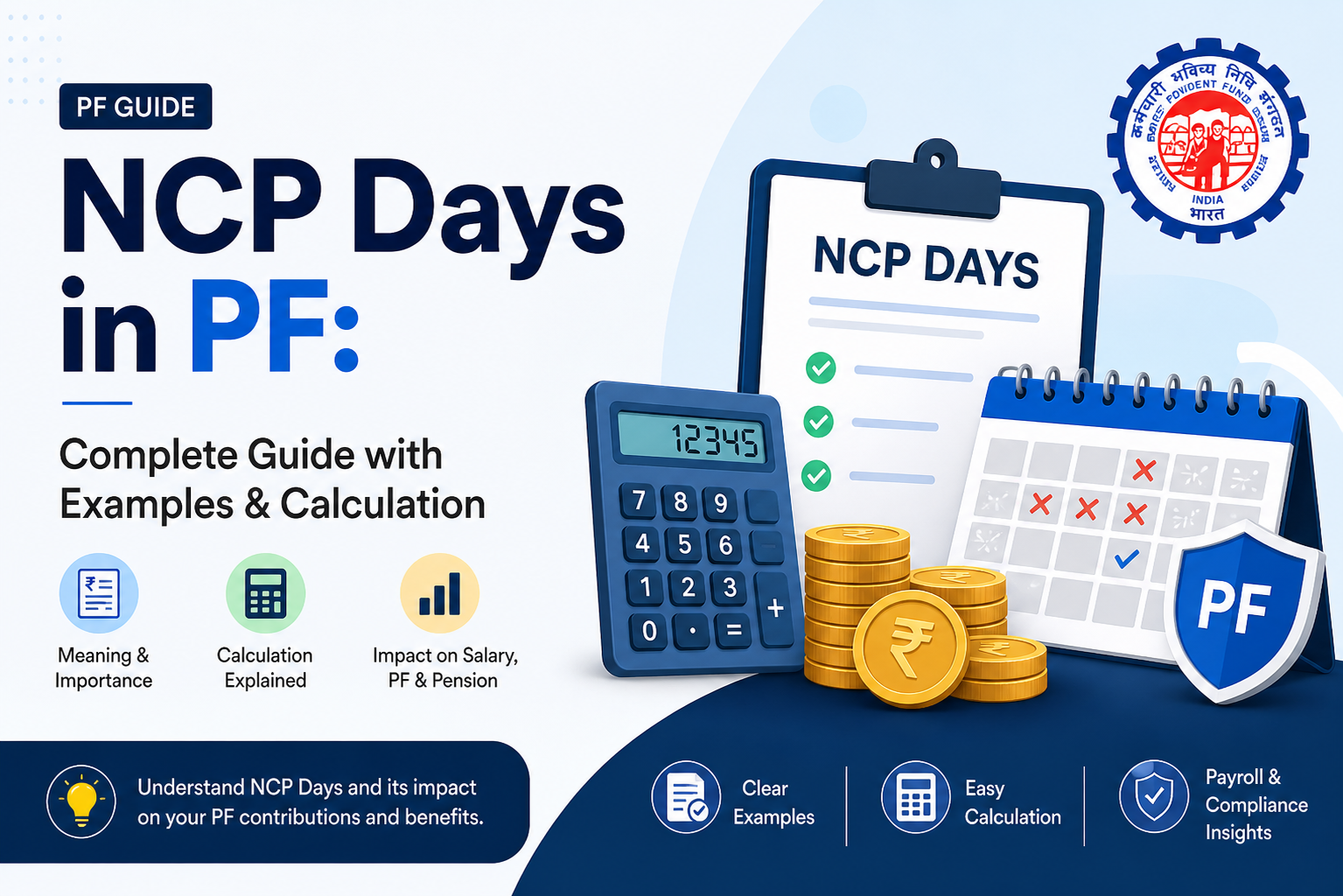
NCP Days in PF: Complete Guide with Examples & Calculation

If you’ve ever checked your payslip or EPF statement, you may have noticed a term called NCP Days. It might seem technical, but it plays a major role in your salary, PF contribution, and pension benefits.

In this guide by Payslip Maker Free, we’ll explain everything about NCP Days in PF in a simple and practical way.

What Are NCP Days in PF?

NCP stands for Non-Contributory Period.

NCP Days refer to the number of days in a month when an employee does not earn wages, and therefore no Provident Fund (PF) contribution is made for those days.

👉 In simple words:
No salary = No PF contribution = NCP Days

Why NCP Days Are Important

NCP days directly affect multiple aspects of your payroll:

1. PF Contribution Gets Reduced

PF is calculated based on your salary. If your salary is reduced due to unpaid days, your PF contribution also decreases.

2. Salary Reduction

More NCP days mean fewer paid days → lower take-home salary.

3. Pension Impact

EPF pension benefits depend on contribution history. Higher NCP days can reduce your total pensionable service.

Common Reasons for NCP Days

NCP days usually occur in the following situations:

  • Leave Without Pay (LWP)
  • Unpaid absences
  • Long leave or sabbatical
  • Suspension without pay
  • Joining mid-month
  • Leaving mid-month
  • Zero salary in a month

👉 Any situation where salary is not paid leads to NCP days.

Difference Between NCP Days, LOP & Absent Days

Many people confuse these terms. Here’s a simple breakdown:

Term Meaning PF Impact
NCP Days Days with no PF contribution Direct impact
LOP (Loss of Pay) Salary deduction due to unpaid leave Leads to NCP
Absent Days Attendance record (paid/unpaid) Only unpaid days count

👉 Important:
All LOP days usually become NCP days, but not all NCP days come from LOP.

How to Calculate NCP Days in PF

The calculation is straightforward:

👉 NCP Days = Total number of unpaid days in a month

Example:

  • Total days in month = 30
  • Unpaid leave = 4 days

👉 NCP Days = 4

Confused about how NCP Days affect your PF and salary?

Calculate accurate deductions and understand every detail in seconds.

Generate Your Salary Slip  

PF Calculation with NCP Days (Example)

Let’s understand how NCP days affect PF:

Scenario:

  • Monthly PF salary = ₹15,000
  • Total days = 30
  • Unpaid days (NCP) = 5

Step 1: Calculate Paid Salary

₹15,000 ÷ 30 × 25 = ₹12,500

Step 2: Calculate PF Contribution

12% of ₹12,500 = ₹1,500

👉 Without NCP days, PF would be ₹1,800
👉 Due to NCP days, PF is reduced to ₹1,500

Real-Life Examples of NCP Days

Example 1: No Leave

  • Total days: 30
  • Unpaid days: 0
    👉 NCP Days = 0

Example 2: Leave Without Pay

  • Total days: 31
  • LWP: 3 days
    👉 NCP Days = 3

Example 3: Zero Salary Month

  • Total days: 30
  • Salary: ₹0
    👉 NCP Days = 30

This is known as a zero-wage month, where no PF contribution is made.

Rules for Reporting NCP Days

Employers must follow these rules while filing PF returns:

  • NCP days must be reported in monthly PF filing (ECR)
  • Only whole numbers are allowed (no decimals)
  • Cannot be left blank
  • If salary is zero → NCP = total days in the month

Incorrect reporting can lead to compliance issues.

Where Can You Check NCP Days?

You can find NCP days in:

  • Your monthly payslip
  • Payroll software or HR portal
  • EPF passbook (via UAN portal)
  • Annual PF statement

Common Mistakes to Avoid

  • Counting paid leave as NCP days
  • Entering fractional values (like 2.5 days)
  • Ignoring zero-salary months
  • Mismatch between payroll and PF filing

These errors can lead to PF calculation issues or rejection.

How to Reduce NCP Days

While some situations are unavoidable, you can reduce NCP impact by:

  • Planning leaves in advance
  • Using paid leave effectively
  • Avoiding unnecessary unpaid absences

Final Thoughts

NCP Days in PF may seem like a small detail, but they have a big impact on your salary, PF savings, and future pension.

Understanding NCP days helps:

  • Employees track their earnings better
  • Employers maintain accurate payroll compliance

FAQs

What is the full form of NCP in PF?

NCP stands for Non-Contributory Period.

Do NCP days reduce PF contribution?

Yes, PF is calculated only on paid days, so NCP days reduce PF.

Are NCP days the same as LOP?

Not exactly. LOP often leads to NCP days, but they are not identical.

Do NCP days affect pension?

Yes, fewer contributions may reduce your pensionable service.

Also Check:

Minimum Wages in Gujarat 2026: Latest Rates & Per Day Salary Guide

Form 24Q (Quarterly TDS Return): Meaning & Deadlines 2026

Is There an SSN Number in India? Everything You Need to Know
Paid Time Off (PTO): Meaning, Benefits & How It Works

What is Form 16?- A Complete Guide

Salary Increment Request Letter:Comprehensive Guide

Asking for a salary increase can feel uncomfortable—but when done correctly, it’s a professional step toward career growth. A well-written salary increment request letter helps you clearly communicate your value, achievements, and expectations.

Using a free payslip generator, you can quickly create accurate salary slips after your increment is approved. It helps maintain clear records for both employees and employers.

In this guide, you’ll learn how to write an effective salary increment request letter, along with ready-to-use templates and expert tips.

What is a Salary Increment Request Letter?

A salary increment request letter is a formal document written by an employee to request a salary increase based on performance, added responsibilities, or market standards.

It acts as a professional way to:

  • Highlight your achievements
  • Justify your request
  • Start a salary discussion with your manager

When Should You Ask for a Salary Increment?

Timing matters a lot. The best moments include:

  • During annual performance reviews
  • After completing a major project
  • When you take on additional responsibilities
  • After a promotion or role change
  • When your salary is below market standards

A strong request works best when it’s backed by measurable results and business impact.

Key Elements of a Salary Increment Letter

To make your request effective, include the following:

  1. Professional greeting
  2. Clear request for salary review
  3. Your achievements and contributions
  4. Reason for the increment (performance, promotion, etc.)
  5. Polite closing and willingness to discuss

A concise and professional tone significantly increases your chances of success.

Simple Salary Increment Request Letter Format

Here’s a clean format you can follow:

Subject: Request for Salary Increment

Dear [Manager’s Name],

I hope you are doing well.

I would like to request a review of my current salary based on my contributions to the team. Over the past [time period], I have [mention key achievements or responsibilities]. Considering my performance and increased responsibilities, I would appreciate the opportunity to discuss a possible salary adjustment.

Thank you for your time and consideration.

Sincerely,
[Your Name]

Best Salary Increment Request Letter Examples

1. Request Based on Performance

Subject: Salary Revision Request

Dear [Manager’s Name],

Over the past year, I have consistently exceeded my targets and contributed to improving team productivity. Based on these achievements, I would like to request a review of my salary. I would appreciate the opportunity to discuss this further.

Thank you for your support.

Sincerely,
[Your Name]

2. Request After Promotion

Subject: Salary Review Following Promotion

Dear [Manager’s Name],

Thank you for the opportunity to take on my new role. With the increased responsibilities, I would like to request a revision of my salary.

I look forward to discussing this further.

Best regards,
[Your Name]

Ready to document your new salary after a successful raise?

Use our free payslip generator to create accurate, professional salary slips in minutes.

Generate Your Salary Slip  

3. Request Based on Market Standards

Subject: Request for Salary Adjustment

Dear [Manager’s Name],

I would like to request a review of my salary based on current industry standards and my contributions to the organization.

I value my role here and look forward to discussing this further.

Thank you for your consideration.

Sincerely,
[Your Name]

Common Mistakes to Avoid

Many salary requests fail due to poor communication. Avoid these mistakes:

  • ❌ Asking without proof of achievements
  • ❌ Using emotional arguments
  • ❌ Comparing yourself with coworkers
  • ❌ Requesting unrealistic hikes
  • ❌ Writing long, unclear emails

A professional, fact-based approach always works better.

Pro Tips to Increase Approval Chances

  • ✔ Use data (KPIs, targets, results)
  • ✔ Keep your tone polite and confident
  • ✔ Be realistic with expectations
  • ✔ Practice your discussion beforehand
  • ✔ Follow up professionally

How Payslip Maker Can Help

Once your salary increment is approved, having accurate documentation is essential. With Payslip Maker Free you can:

  • Generate professional payslips instantly
  • Track salary changes and increments
  • Maintain clear salary records for future reference

This ensures transparency and helps during job switches, loans, or financial planning.

Final Thoughts

A salary increment request letter is more than just a formality—it’s your opportunity to showcase your value. When written clearly and backed by results, it can open the door to better compensation and career growth.

Take the time to prepare, stay professional, and make your case confidently.

FAQs: Salary Increment Request Letter

1. What is a salary increment request letter?

A salary increment request letter is a formal document written by an employee to request a raise based on performance, responsibilities, or market standards.

2. When is the best time to ask for a salary increase?

The ideal time is during performance reviews, after completing major projects, or when you’ve taken on additional responsibilities.

3. How do I justify my salary increment request?

You should include measurable achievements such as:

  • Meeting or exceeding targets
  • Increased responsibilities
  • Contribution to company growth

4. What should I avoid in a salary increment letter?

Avoid:

  • Emotional language
  • Complaints about colleagues
  • Unrealistic salary expectations
  • Vague or unsupported claims

5. Can I ask for a salary increment via email?

Yes, email is a common and professional way to request a salary increase. Ensure your message is clear, concise, and formal.

6. How long should a salary increment letter be?

It should be short and precise—typically 150–250 words—focusing only on key achievements and your request.

7. What happens after my salary increment is approved?

Once approved, your employer updates your compensation structure. You can then generate updated salary records and payslips using tools like PayslipMakerFree.com.

8. How much salary increment should I ask for?

This depends on your performance, industry standards, and company policies. Typically, increments range from 5% to 20%.

Also Check:

Minimum Wages in Gujarat 2026: Latest Rates & Per Day Salary Guide

Form 24Q (Quarterly TDS Return): Meaning & Deadlines 2026

Is There an SSN Number in India? Everything You Need to Know

Paid Time Off (PTO): Meaning, Benefits & How It Works

What is Form 16?- A Complete Guide